From The Studio of Torsten Malm | Tallinn, Estonia

Beginners and professional tattoo artists...
How using a step-by-step proven system can help you become a skilled and fully booked tattoo artist
Zero Experience Or 15 Years In — The Same System Takes You To $20K–$40K+ Months.
No ego. No "watch me tattoo." No upsells. Just the system, 20+ courses, and a mentor who actually answers.

For over six years, I've helped hundreds of tattoo artists refine their skills and scale their businesses to $20,000-$40,000+ per month. What I'm about to share with you is the simplest, most straightforward, step-by-step system to transform your tattoo career.
I took my 1:1 coaching program for tattoo artists and turned it into the Artist Growth Masterclass Accelerator (AGMA). This is a step-by-step system with 20+ courses, group coaching, and community for:
- Beginners with no experience. You have watched a hundred hours of YouTube and every video says something different. Nobody gives you a straight answer on how to hold the machine or how deep to go, and no one has ever looked at your own work and told you what is wrong with it. Here you start at lesson one, in the order that actually works, and your work gets critiqued by name.
- Experienced artists whose work is good enough to charge for but not good enough to be proud of. Blacks heal patchy, saturation will not hold, transitions go muddy, and you have stopped looking at your linework. Nobody will tell you which one is the real problem. Here they get named and fixed, one at a time.
- Professionals ten, fifteen, twenty years in who reached the point where they no longer knew how to improve. The artists above you will not share what they know, the ones who will want thousands for it, and you are still looking at healed work you cannot explain. Here nothing is gatekept, and you get answered directly.
Starting or growing a tattoo career is hard. There were so many days when I questioned myself:
“Will this work? Can I do this? How will I find clients?”
For years, I worked nonstop—balancing a 9-to-5 job while spending another 6-8 hours each night working on my skills. Most people quit during this stage, but I made a vow to myself and my wife Katlin that we would never feel stuck or powerless again.
Through years of trial, error, and mentorships (over $32,000 invested!), we built a seven-figure tattoo studio. We cracked the code on techniques and tricks that "mentors" usually gatekeep from the industry — not just in tattooing but also in the business side of things, like acquiring clients and keeping our calendar fully booked with high-paying clients, all while working on projects we love.
If I only knew then, the things I know now... I could have gotten to this level in 1/10 the time.
This journey was far from easy. It took 14+ years of relentless experimentation, sleepless nights, and determination. But the lessons I’ve learned can help you shortcut that journey.
But first... Why listen to me?

Not only have I achieved international recognition with my tattoo art, but I’ve also been awarded in numerous conventions, judged international competitions , and collaborated with superstars.

My work has been featured in countless magazines and books, and even showcased in the National Museum of Estonia.

I currently work with high-paying international clients who fly to Estonia just to get tattooed by me.

And I’m not just a sponsored artist, but I’m in a position right now that I have so many applications, so I can choose ONLY brands that I respect and use to be sponsored by.

The amount of watered-down, complicated, or stupid information I see out there makes me furious.
I’ve been through it all: wasting thousands of dollars on overpriced workshops, and navigating gatekept industry secrets for years.
That’s why I created the AGMA Masterclass — a step-by-step system that gives you all the tools, techniques, and strategies to become an A+ artist, whether you’re just starting out with no experience or you’re an experienced pro looking to scale your business to $20,000-$40,000+ months.
Now you may ask "How the system works and what You'll learn inside the agma masterclass?"

Here's Just A Fraction of What You're Getting Inside the AGMA Masterclass
🔴 Foundations
Maybe nobody taught you. Maybe somebody taught you wrong. Hygiene learned from a mentor who was guessing. Cross-contamination nobody flagged. Infections blamed on the client. Needle theory nobody could explain, mid-tapers you had never used, an owner who handed you a machine and said go to work. One member asked out loud whether he was being taught badly on purpose so he would never become competition. Another spent his apprenticeship as a stencil maker. Meanwhile you have watched the symptoms for years: blacks that heal patchy, work that fades, clients back for repairs you blamed on their skin, or on being "light-handed." Those were never mysteries.
So we start at the bottom and check every assumption. Hygiene and cross-contamination first, before a single technique. Needles, diameters, tapers and what each one is actually for. Machines, tuning, and why so much falls into place once you understand them. The skin itself and how it takes ink. This is the course artists at seven and eighteen years finish saying they would be a tier higher today if they had seen it a decade ago.
🔴 Techniques
You are working blind and you know it. Blood and redness cover the color going in. Everyone tells you that you will feel the right depth, you cannot feel it, and nobody will say what you are feeling for. So you pass over it again, and again, and that is the overworking, and you will not know for three weeks. Blown lines three days into the heal with no idea what caused them. Wobbly lines that were clean on the day. Saturation you have banged your head against for years. Shading that goes scratchy the second you speed up, usually because the client is hurting and you think going faster is kindness. Fix the stretch and you start blowing out. Voltage up and it heals rough, voltage down and you are chewing skin. Then you tell them it needs a touch-up.
So this course hands you the whole map, with videos, PDFs, exercises and stencils. Needle depth and entry angle. Diameters and tapers. Stretch. Machine tuning, voltage and stroke. Linework, saturation, shading, color packing, details, textures and color transitions. Not as a list of skills to collect, but as cause and effect, so you can look at a healed piece and know exactly which decision produced it.
🔴 Black & Grey
Nobody ever told you how deep to go, so you have been frightened of the skin your whole career. You go soft, then go over it four more times, and do the exact damage you were avoiding. One artist here put it plainly: too scared to cause damage, so too gentle, so damage. Your lightest wash still reads dark. Three cups of dilution and it still comes out black. Your blacks look solid in the chair and patchy in the photo on the drive home. Three weeks later it heals lighter than anything you put in. You cannot hit the same value twice, even with the same drops. Fifty shades of grey, every time. One member had six good months of black saturation and then lost it again. Another ended up warning clients in advance that she struggles with blackwork and they would need a touch-up. So you stop offering black and grey, and tell yourself it was never your style.
So this course fixes the values first. Where the real depth limit sits, so you stop being tentative. How to mix and control greywash so your lightest tone stays light. Smooth transitions, depth and contrast. How to build a design so it still reads from across the room in ten years, not just on the day. And how to repeat a value on purpose, so your practice finally compounds instead of starting over every time.
🔴 Opaque Grey & Sepia
You have been saying eventually for years. Full saturation still feels like it will chew the skin, so you stay in grey wash, where everything comes out darker than you meant and you cannot take it back. Go too dark and there is no going over it. A sixteen year artist here admitted he never knew whether to work dark to light or the other way round, and had been all over the place the whole time. Nobody has told you where the limit is, and you cannot feel it either, so you find out when it heals. One member logged nine hours on a single opaque forearm and then knocked chunks off the price, unsure whether packing opaques is even something you are allowed to charge more for. And sepia is a word you have heard a hundred times and never had defined.
So here it gets defined. The exact blueprint for flawless application: the mix, the needle groupings, the chroma, and which direction to work in. How far skin will actually take it, and how to read the limit before you cross it rather than three weeks after. The cover-up work opaques were built for, which almost nobody teaches. What it costs you in chair time and why that belongs in your price. This is the stepping stone to color that lasts, and it is the reason artists join after seeing how these heal.
🔴 Color Realism
You have watched color realism in awe for years and never found anyone willing to show how it is actually done. Maybe you never tried at all, paralyzed by it for as long as you can remember. Maybe you tried once. The whites and the light tones would not go in, so you passed again, and again, until the skin went to leather under the needle. It healed patchy, or scabbed, or scarred. Three months later the client messaged to say she cannot see the purple anymore. On darker skin it barely stayed at all and nobody has ever explained why. Your blacks wipe into your light tones and the whole thing turns to mud. You can paint color on canvas and freeze the second it is skin. And you cannot mix the same color twice, so nothing you learn carries to the next piece.
So this is step by step, from design through to advanced application. Color theory that works on skin instead of paper. Mixing, and mixing repeatably. Selecting pigments and adapting to different skin types, including the ones nobody teaches you to read. Why dirty dipping is killing your light tones. What full saturation looks and feels like before the skin is chewed. And the transitions that make fur, feathers, hair, wood and metal read as real instead of painted on.
🔴 Advanced Tips
Seventeen years, and it feels strange to say out loud. An artist here said exactly that, that it is weird to say the number, because she still feels like she has everything to learn. Another, twenty-five years in, called himself a stranger in this day and age of tattooing. The work heals in ways you cannot explain and nobody around you can tell you why. What you were taught was never right, and the bill has come due a decade late. The people who could fix it have egos, or gatekeep, or want four thousand for a weekend. One member spent ten thousand across three seminars in two years and came home with notes he could not use. And underneath all of it, the thing almost nobody admits out loud: the fear of being found out as a fake. A long-standing member here said exactly that, and added that he knows it too well, because he was one of them.
So this is the layer nobody discusses in public. The pro-level decisions that separate work that is consistently excellent from work that is only sometimes good. The uncommon topics that matter and never get talked about anywhere. And most of all the why underneath the result, so you can diagnose your own healed work instead of guessing at it. The younger artists are not beating you because they are younger. They are beating you because the shops stopped progressing and nobody told you. Your years should be counting for more than this. Here they start to.
🔴 Procreate Training
The stencil prints as a blue blob and you are guessing which line to follow with the client already in the chair. One member called it a big stain. Another said it was too messy to tell which mark was a line and which was a shadow. Either too much detail on it or not enough, and no way to find the balance. All the detail you spent the evening on never reaches the skin. A blank canvas with a whole arm to fill and no idea where the focal point goes. You know the app well enough to trace and not well enough to design. Large pieces you cannot split and print without a computer and Photoshop. One artist's printer died, he spent an hour failing to fix it, and cancelled the client. Another cancels paid appointments because, in her own words, she just does not see it. And on a stencil thread an artist wrote that he swears there is some secret nobody is sharing, and he is angry about it.
So I walk you through my entire workflow. Canvas setup, building a design from nothing, and where the focal point goes. Stencils that read at a glance instead of printing as a blob. Splitting and printing large pieces without a computer. The tricks and shortcuts that cut hours off every design. You stop being limited to what you can technically produce, and start making what you actually pictured.
🔴 Photography for Artists
The tattoo was right. The photo is wet, blown out, half stencil, so you post the apology under it or you do not post at all. One artist here called a client back two hours later purely to reshoot. Another had no usable photo of his best sleeve at a convention, so he entered an older healed tattoo instead and placed third with it. Buying a camera does not fix it either: one member's Canon lost to his own iPhone, and another found that without proper light nothing helped whichever body he used. Work has been lost permanently because it was never photographed at all. And the photo does not only undersell the work, it exposes it.
So this course starts with light, because light is the actual variable. Lighting and glare, the CPL and polarized setup, the ten minute rest before you shoot. Composition. Editing that is honest rather than flattering. The phone settings quietly wrecking your uploads. And how to read your own photograph properly, because the shot that flatters your work is the same one hiding what still needs fixing.
🔴 Business Accelerator
Thirteen years in, owning the shop, and still fighting to make rent. A rate you have not raised in five years because you were never certain you could defend it. Quotes you shave down yourself, because you assume you are too slow. No-shows, because the deposit was never big enough to bind anyone. In a shop you closed nearly every consultation, and on your own you close almost none, and nobody ever told you that was a separate skill. A calendar filled by whatever walked in, still run at the volume pace a shop trained into you years ago even though you went private. Evenings lost to admin, then designing at home after a twelve hour day.
You just want to tattoo. Succeeding now takes more than putting ink in skin, and none of it means becoming an influencer, posting your face, or doing skits. This is your number and how to defend it. Deposits that actually hold. The rules that stop clients walking over you. Turning a consultation into a booking now that nobody is doing it for you. Managing the money and the workflow so the business stops eating your evenings. A clear, step-by-step roadmap to scale a personal brand or a studio to $20,000 to $40,000+ a month.
🔴 Branding & Social Media
The footage is sitting on your phone and has been for a month, because you tattoo every day and editing is a second job nobody pays you for. Meanwhile artists whose work is worse than yours stay booked, because they post daily. I have watched genuinely talented artists get to the point where they are begging on Instagram to find work. You have seen what the alternative takes, the skits and the face and the talking, and one artist here said it feels like spitting on himself. Another said he will one hundred thousand percent not do skits or videos. You are not refusing because you are lazy, and you are not uninterested either. Artists here say in the same breath that they hate it and that they want somebody to show them a way through it. What they get offered instead is generic advice, an algorithm nobody can explain, and follower counts that never turn into bookings. Ten thousand followers, fifty thousand views, and the new followers were all other tattoo artists.
So this is a system built for tattoo artists specifically. What to post so the right clients find you, rather than the work you least enjoy doing. How to stay visible without performing, for people who are never going to be performers. Why your photographs sit upstream of the whole strategy. How to read your own profile honestly, when nobody will tell you it is boring or that it has no consistency. And how to stay fully booked with the projects you actually want.
🔴 Paid Ads
You told yourself that if the work got good enough the clients would come. The work got good. The clients did not. So you discounted, and they came for the cheap price, and eighty percent of them never came back. It has not been a slow season. One artist ten years in put it plainly: it was always hard to find clients and it is still hard today. Marketing is the hardest part of this job and nobody ever taught it to you, so you would rather pay to be seen than spend two hours a day performing for a feed.
So this is a plug and play system for buying clients instead of auditioning for them. Set it up once and it keeps working while you tattoo.
🔴 Convention Blueprint
The judges walked past your piece without stopping, and nobody told you why. Two artists here describe that exact moment in almost the same words. So you go home guessing, and the guess is always that you are not good enough. One member admitted that what he was really afraid of was getting laughed at for being bad. Another spent her first convention crying in a bathroom. Meanwhile the artist two booths down came home with a trophy and you still do not know what they did differently. Most artists never enter at all. They wait until they feel ready, and ready never arrives.
It is almost never talent. It is the category you picked, the entry deadline you missed, the model who cancelled twice, the client who never came back on Sunday to be entered, the piece that ran late on day one, the photograph that was not good enough to submit. So this covers which category to enter and why that decides your odds before you tattoo anything. When entries actually close. What the judges are scoring, from someone who has judged internationally. How to plan a piece that finishes on time and photographs properly. And what to do with a placement once you have one.
🔴 4 Coaching Calls per Month
Ask another artist what is wrong with your work and you get one of two answers. Polite, which teaches you nothing. Or your work called shit, which teaches you nothing either. One artist here said that is her entire experience of asking. It is why the first thing people write when they post work for critique, before a single tattoo has even been discussed, is that this is terrifying.
So this is where that stops. You put the work up and it gets looked at properly, by someone better than you, while there is still time to change something. Personalized critique on your own tattoos rather than general advice. Q&A on whatever you are stuck on that week, a technique, a project, or simply where to go next. I run these myself, so you are not buying videos and then never hearing from anyone again. It is the difference between finding out in three weeks and finding out now.
In addition, you’ll also have access to the following bonuses:
🎁 Daily Access to Me
You have a question at eleven at night with a client booked for the morning. You ask an artist on Instagram and they are busy, or they never reply at all. You ask in a group and you get four different answers from four people who are also guessing. One member described exactly that: plateauing, with nobody to talk to when the questions came up. Another said other platforms promise feedback and then nobody answers, or only other learners answer, every one of them saying something different. That is the whole industry. You buy the videos and you are supposed to be grateful.
So you get me, daily. Guidance on a technique, feedback on a piece, or an answer to the question you would otherwise sit on for a week and solve wrong. Ask before the client is in the chair instead of after. And ask anything you want, because nobody here is going to make you feel stupid for asking it.

🎁 Online Seminars & Workshops
A seminar is how this trade has always passed knowledge down. Fly somewhere, pay thousands for two days, take notes, fly home. One artist here, twenty-eight years in, said the few people who did share anything charged astronomical amounts, impossible unless you were already successful. And you get one pass at it. Whatever you did not catch in the room is gone, and the artist you paid to watch is not answering your messages the week after.
So every seminar and workshop I run is included, and so are the ones from other top artists in the industry. Watch live as the whole process runs from designing and creating the stencil through to executing the tattoo itself. Then watch it again next month, when you are finally doing that thing yourself, because they are yours to keep. Members go back through the older sessions constantly, and that is the point. You are not paying for a weekend.
🎁 Coupon Codes
Ink, cartridges, machines, grips, needles. It never stops, and it comes out of the same money you are trying to protect by raising your rate. Most artists simply absorb it as the cost of doing the job, and never think to ask whether they are paying the same price as everyone else.
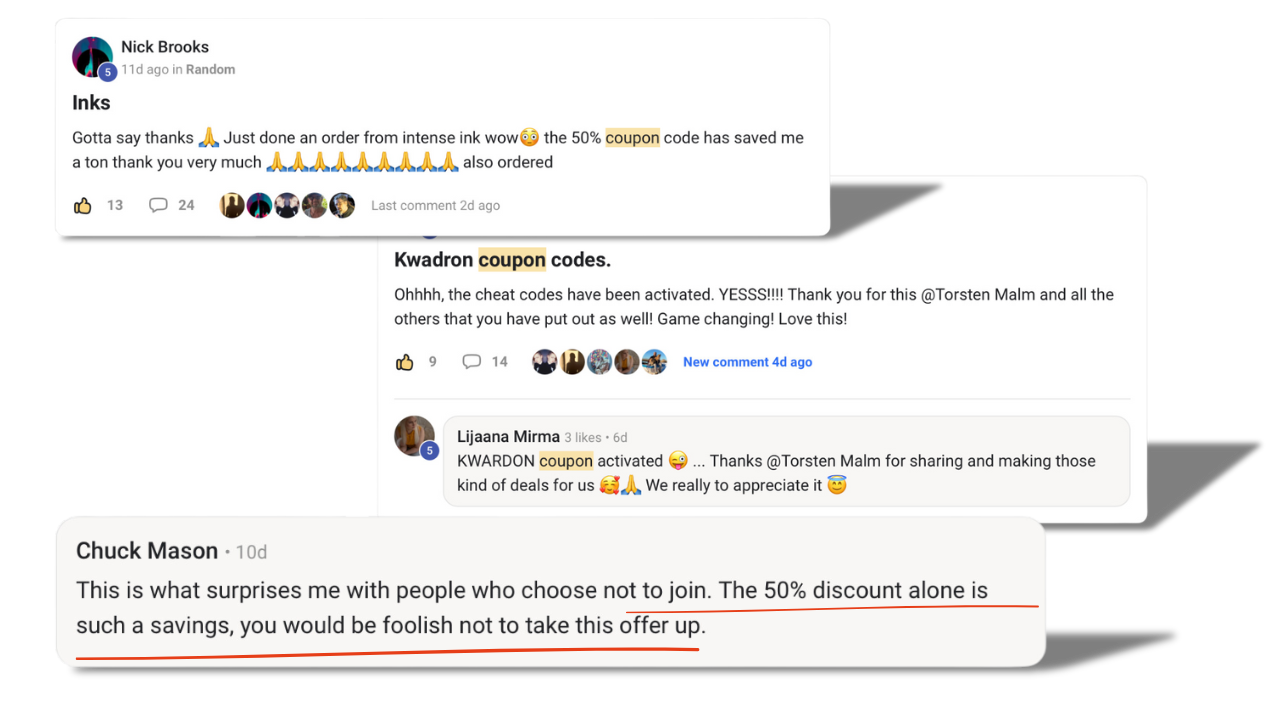
So you get the codes. Up to fifty percent off inks, machines and supplies, from brands you are already buying from. One member came back from a single order to say the fifty percent code had saved him a ton. Another put it more bluntly, that the discount alone is such a saving you would be foolish not to take this offer up. He was talking about the people who choose not to join.
🎁 Collaboration Opportunities
You work in one shop, in one town, and the artists you know are the ones you already knew. The trade does not make that easy to change. Ask a shop how to get in and you can be told you have a better chance at becoming a doctor, or simply to go find another profession. One member here said what he needed most was an apprenticeship he could actually reach. Isolation is not only lonely, it is why the work stops improving. Nobody to travel to, nobody to watch, nobody whose shop you could stand in for a week.
So you get the room, and everybody in it. Guest spots, apprenticeships, and collaborations with artists and studios around the world. One member wrote that there are people here he would happily go and visit, and that he already has. Work beside other professionals, show what you can do somewhere other than your own feed, and come back with a portfolio that proves you were there.
🎁 Certificate of Completion
You’ll receive your certificate of completion, for flexing on the wall of your studio.
🎁 A Thriving Community
The first thing most artists write when they post work for critique, before a single tattoo has even been discussed, is that this is terrifying. One member lurked for a year before posting anything. Another for three. They are not afraid the work is bad. They are afraid of the answer, because everywhere else the answer is one of two things. Polite, which teaches you nothing. Or your work called shit, which teaches you nothing either. One artist here said that is her entire experience of ever asking.
So here is what actually happens instead. Over 1,200 artists, and the ones with the most experience ask the most questions. A member whose work has been praised by convention judges replied to somebody who had never touched skin with a single word: saaaaame. Nearly half the artists arriving here have five years or more behind them, and plenty have thirteen. Watching somebody better than you admit what they are still working on is what makes it safe to admit yours. That is the whole thing. Not a feed. A room where nobody is pretending.
🎁 Monthly Giveaways
Win monthly giveaways worth up to $1,000, featuring top-quality tattoo supplies such as inks, machines, and more.
HOW MUCH?
🙌 It's NOT $10,000 like the course I just bought lol.
HERE's The price:
☕ $1.20/Day. Less than the price of a cup of coffee ($39/mo).
How to sign up:
📲 Click The Button Below - PRICE INCREASING SOON.
🔒 Join Risk Free - 14-Day Money Back Guarantee!
❗️If you are reading this on , price going up to $98/mo SOON - Join now and lock your price to $39/mo forever! (cancel anytime)
*you will be re-directed to my Skool page to join.
Meet SOME Students Below...
and why they joined the Masterclass
1. Apprenticeships — couldn't find one, or it failed them
An apprenticeship can be the best thing that ever happens to an artist. But you have to find one, it has to be a good one, and the person teaching you has to actually have time for you. That's three things that have to go right
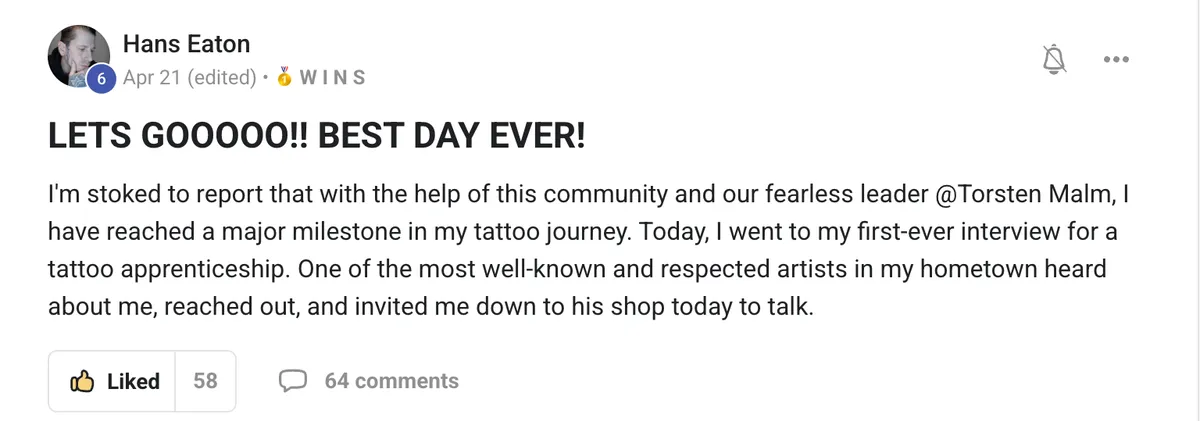
"One of the most well-known and respected artists in my hometown heard about me, reached out, and invited me down to his shop today to talk."
Read more apprenticeship stories
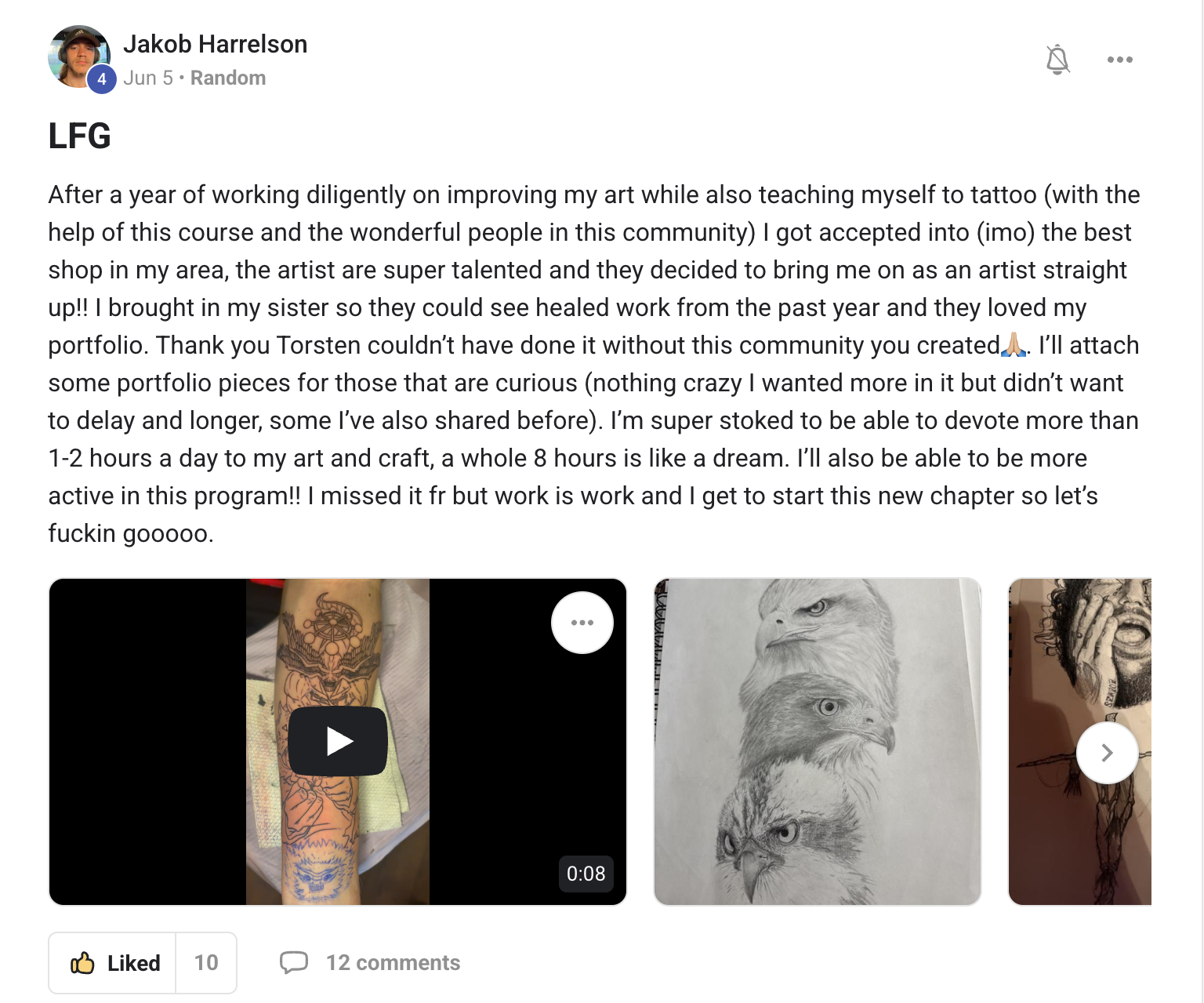
"I got accepted into (imo) the best shop in my area, the artist are super talented and they decided to bring me on as an artist straight up!! I brought in my sister so they could see healed work from the past year and they loved my portfolio."
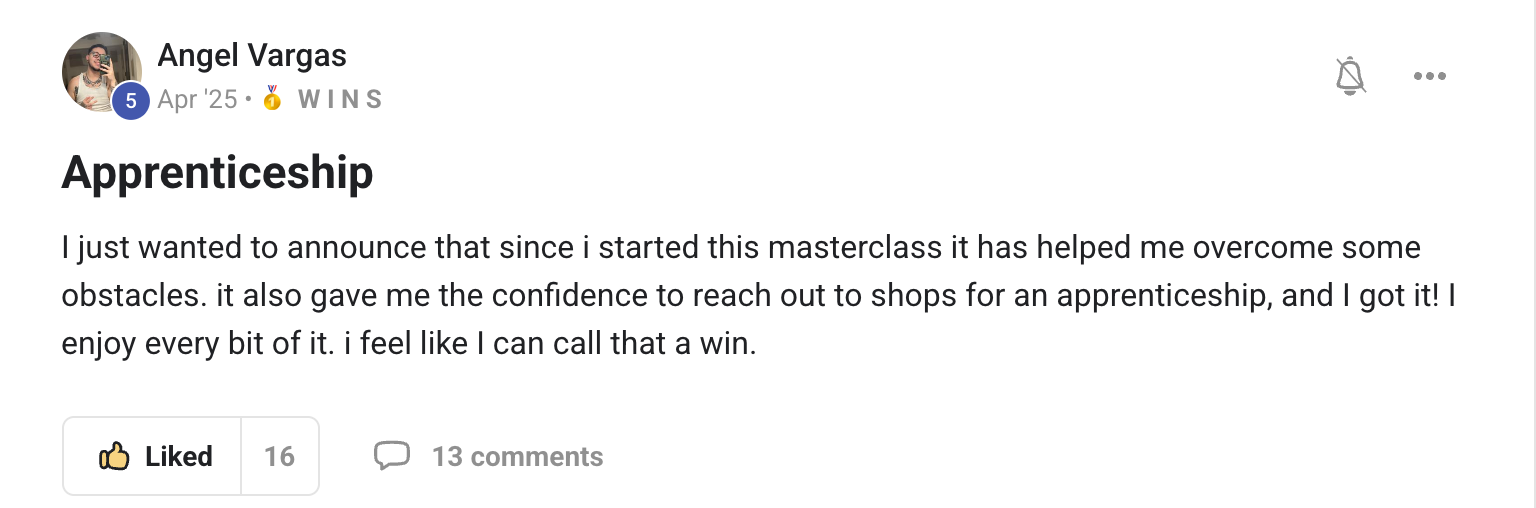
"Since i started this masterclass it has helped me overcome some obstacles. It also gave me the confidence to reach out to shops for an apprenticeship, and I got it!"
"I won 2nd place. All of the participants were working under the guidance of experienced artists in studios. I wasn't — I was the only one tattooing "from home" and only one day a week."
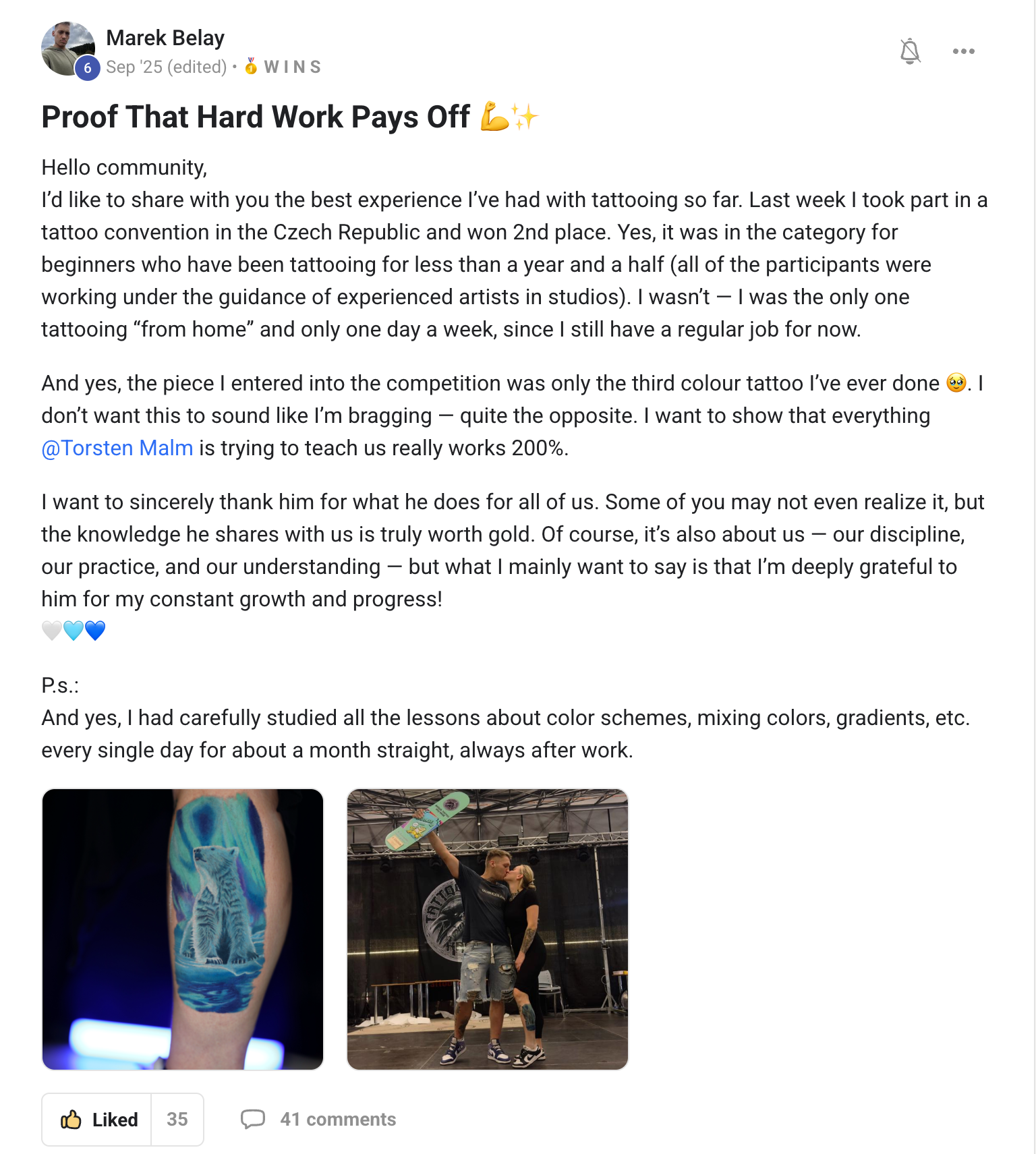
"This community is so much help that before this I thought I needen't...It's like having a personal professional teacher that you can ask everything and he will gladly reply to you in detail!"

2. FEEDBACK — CAN'T SEE THE MISTAKE, AND NOBODY WILL NAME IT
You can't fix what you can't see. The client says they love it, your friends say it's sick, and the likes tell you nothing. So you guess. You change something, and three weeks later the healed photo says that wasn't it either. That's how you get ten years better at your own mistakes.
"I realized that actually my hand movements were not the issue, it was machine set up and needle choices. I am now saturating black 10x better"
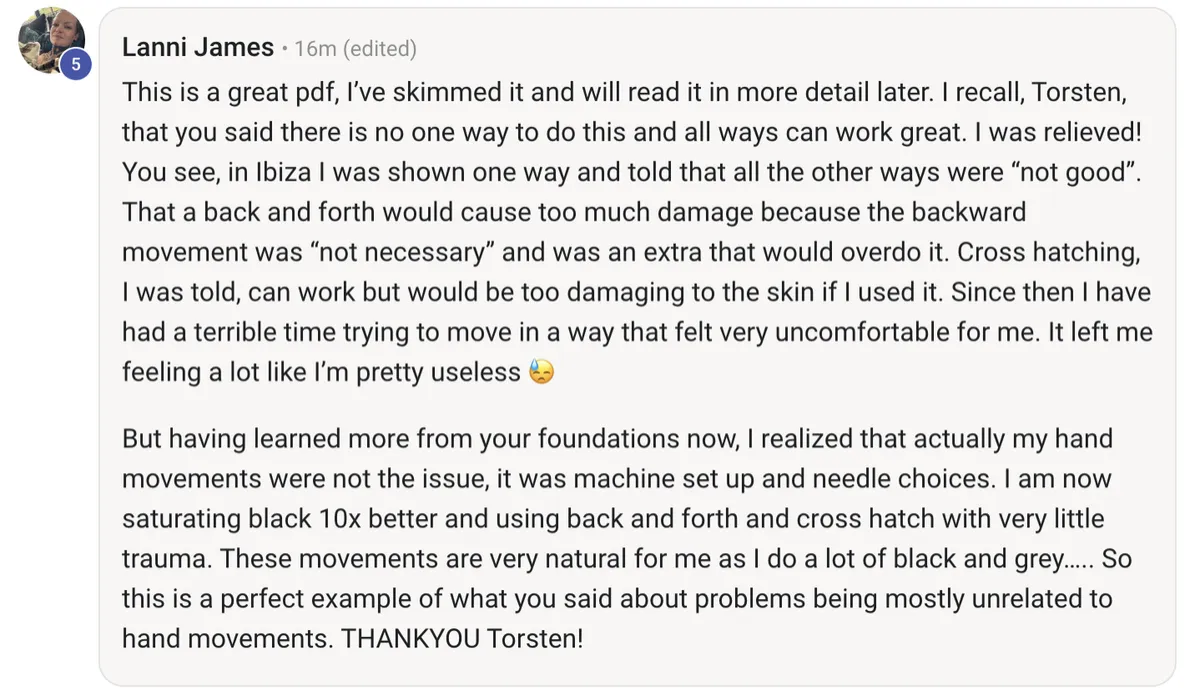
Read more feedback stories
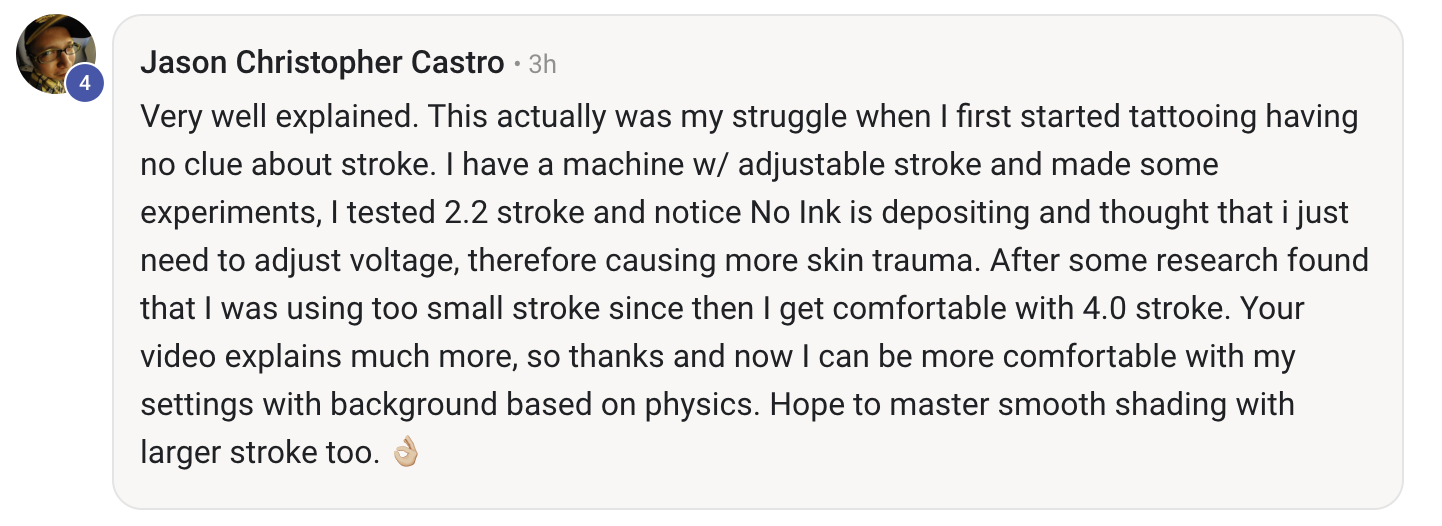
"I tested 2.2 stroke and notice No Ink is depositing and thought that i just need to adjust voltage, therefore causing more skin trauma. After some research found that I was using too small stroke"
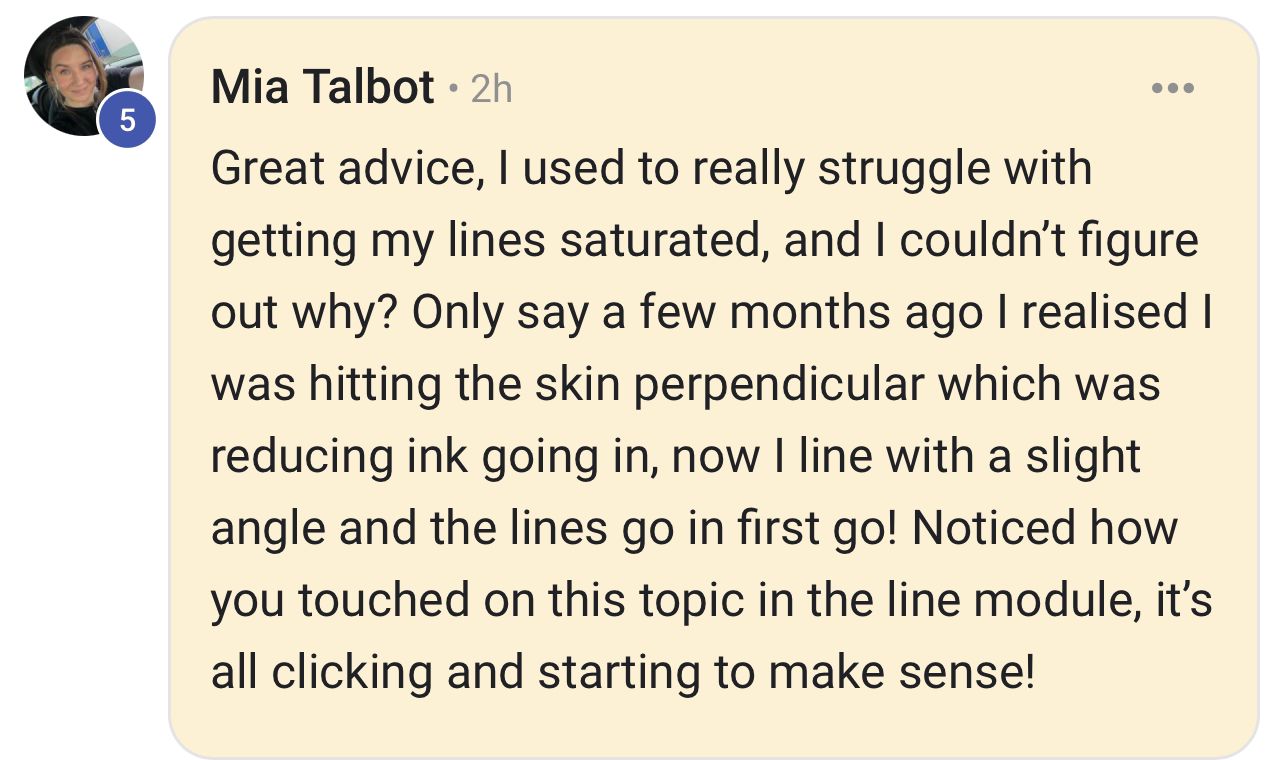
"I used to really struggle with getting my lines saturated, and I couldn't figure out why? Only say a few months ago I realised I was hitting the skin perpendicular which was reducing ink going in, now I line with a slight angle and the lines go in first go!"
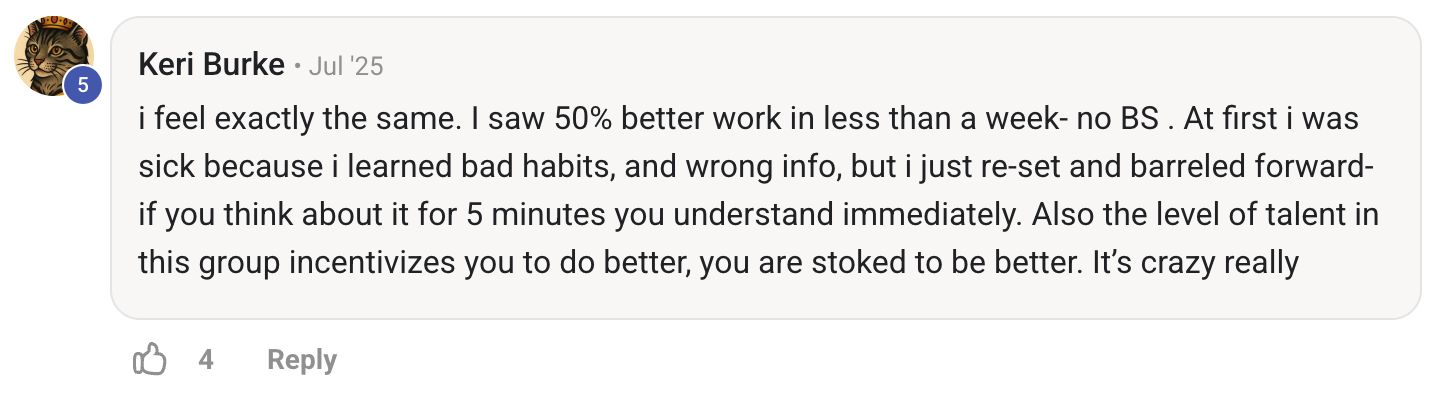
"I saw 50% better work in less than a week- no BS . At firsrned bad habits, and wrong info, but i just re-set and barreled forward"
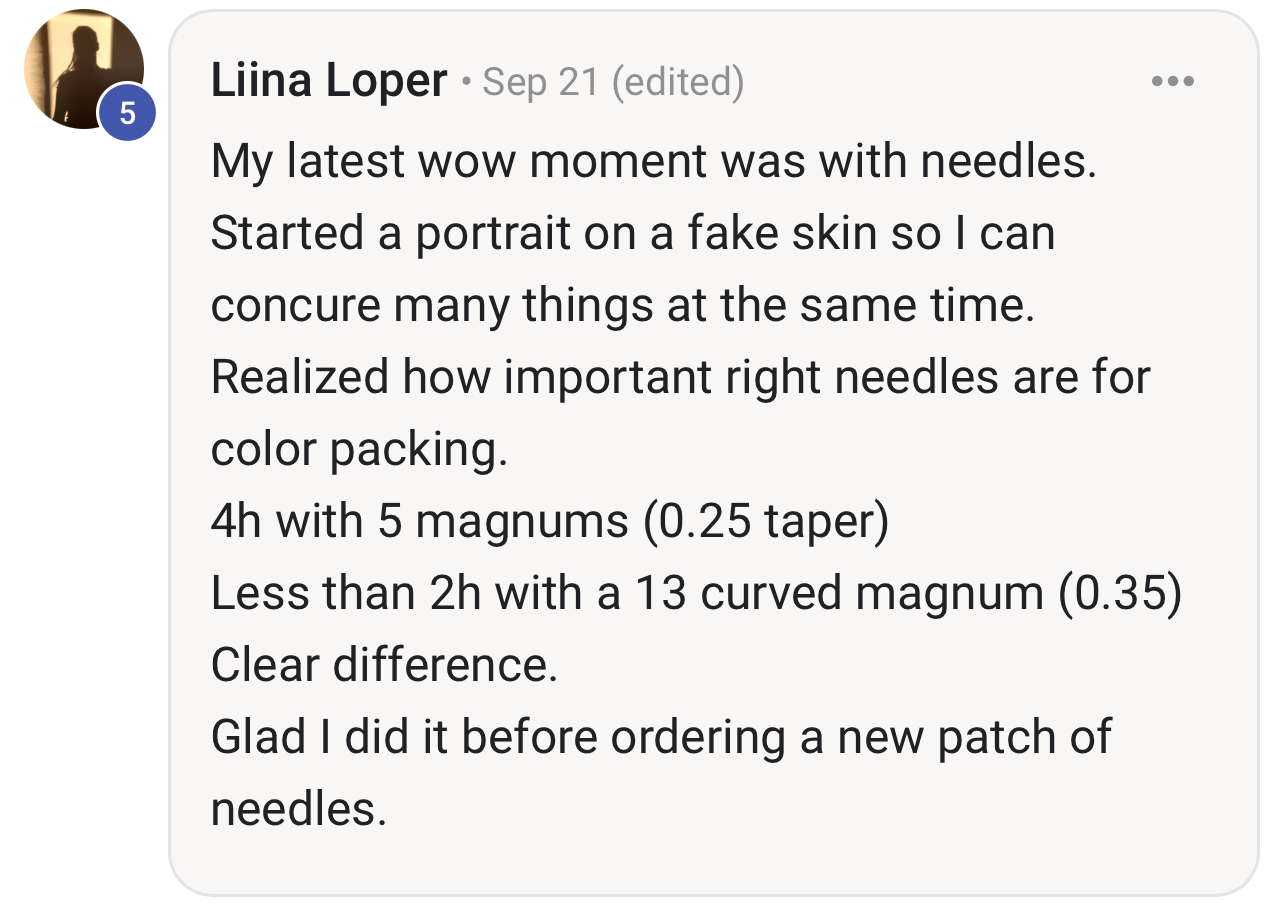
"Realized how important right needles are for color packing. 4h with 5 magnums (0.25 taper). Less than 2h with a 13 curved magnum (0.35). Clear difference."
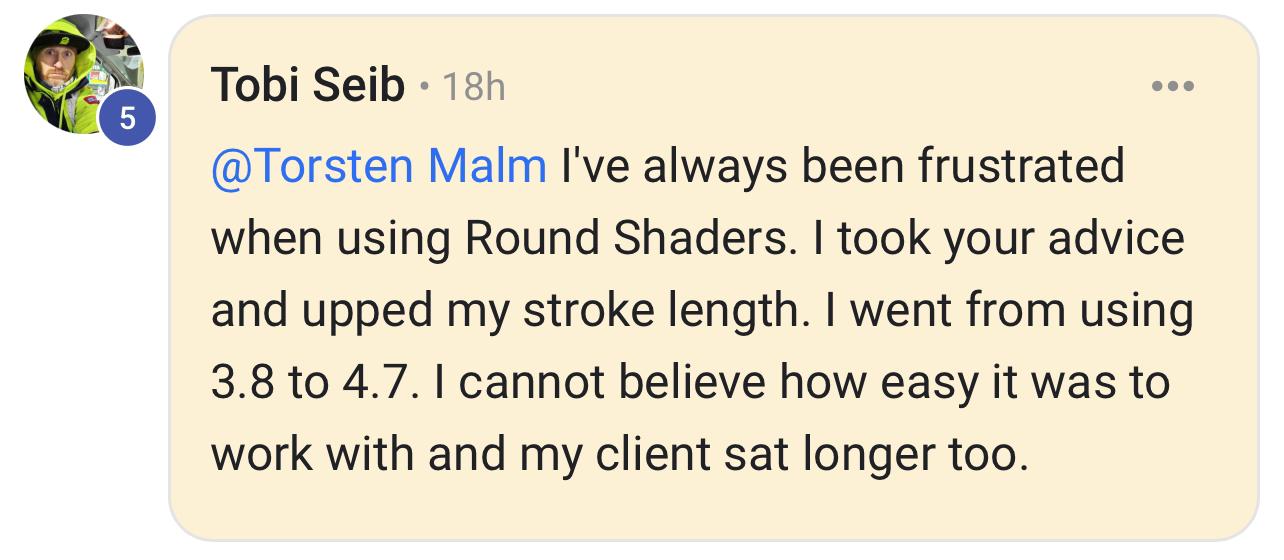
"I've always been frustrated when using Round Shaders. I took your advice and upped my stroke length. I went from using 3.8 to 4.7. I cannot believe how easy it was to work with and my client sat longer too."
3. STARTING OUT — NOBODY WILL TEACH YOU, AND YOUTUBE WON'T TELL YOU WHAT COMES FIRST
You bought the machine. Maybe it's still in the box. You've watched a hundred videos and every one told you something different. Start with lining. No, start with drawing. No, you shouldn't be near skin yet. Ask a real artist and half of them look at you like you're stealing something. So the machine sits there. A year goes by and you're no closer than the day you bought it.
That's not a talent problem. Nobody ever gave you an order to follow. That's what a proven step-by-step system is for: you start at the beginning, and the only way to get it wrong is to skip ahead
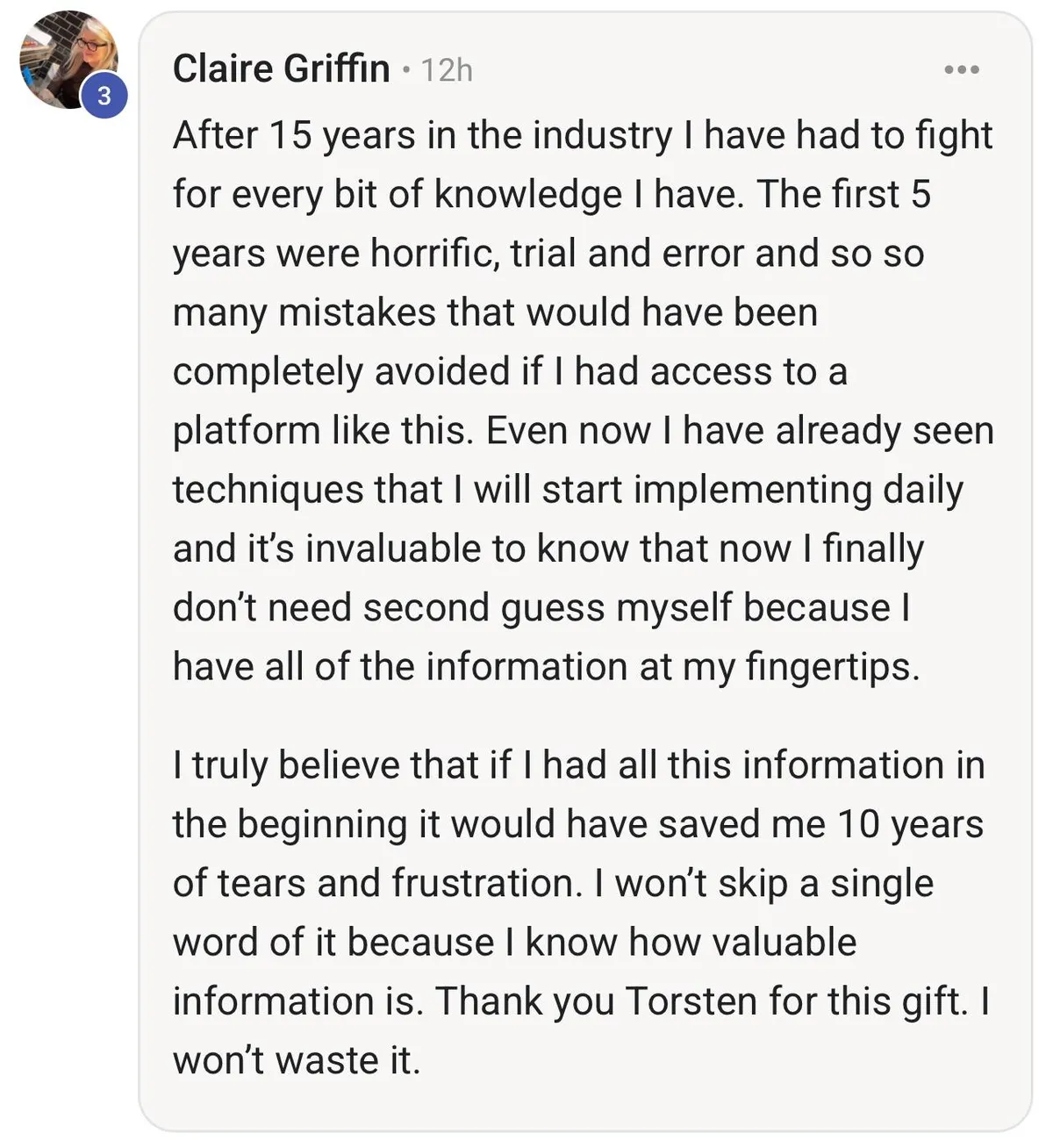
"After 15 years in the industry I have had to fight for every bit of knowledge I have... it would have saved me 10 years of tears and frustration. I won't skip a single word of it."
Read more starting out stories
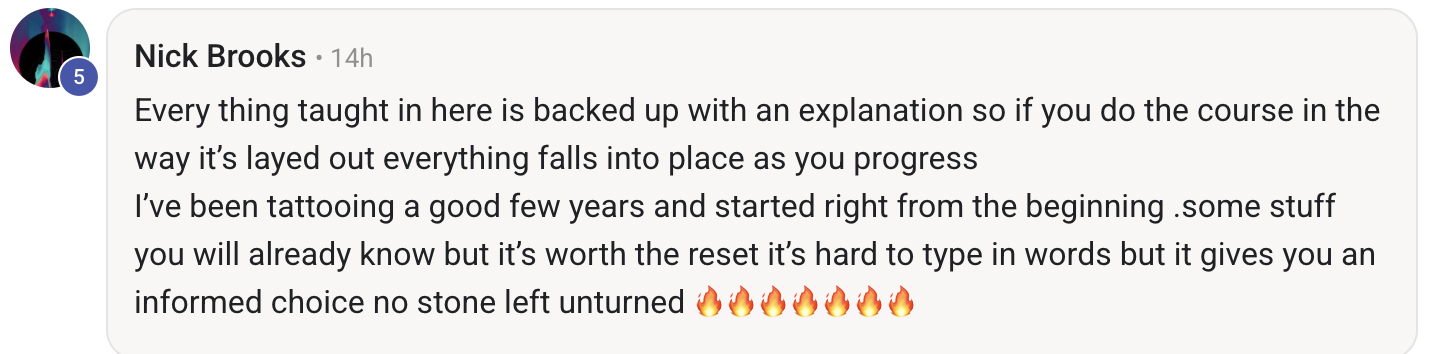
"Every thing taught in here is backed up with an explanation so if you do the course in the way it's layed out everything falls into place as you progress"
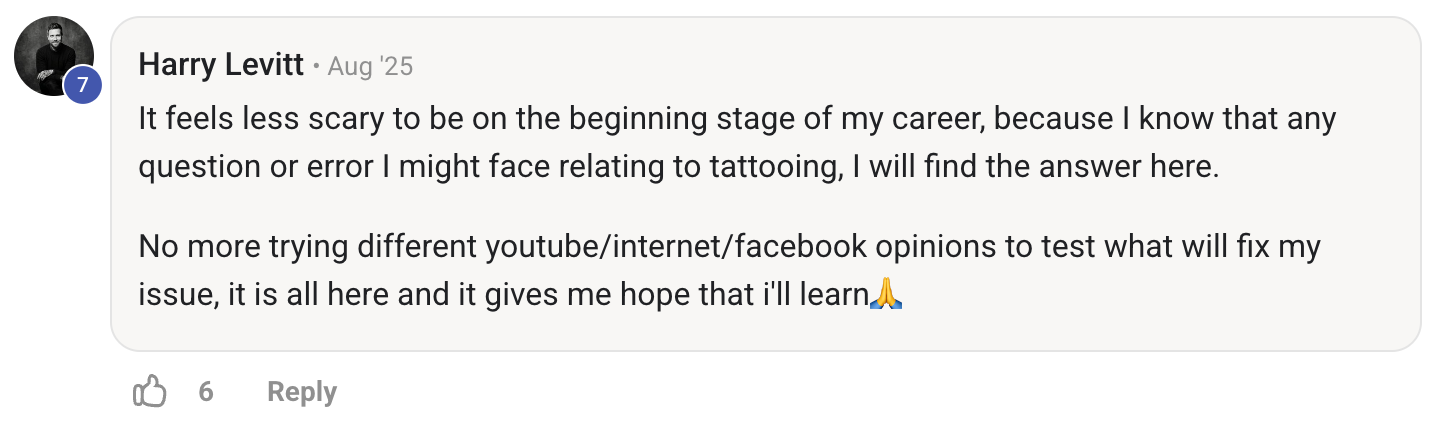
"I know that any question or error I might face relating to tattooing, I will find the answer here. No more trying different youtube/internet/facebook opinions to test what will fix my issue, it is all here"
"The biggest benefit is having the correct knowledge available at hand. I don't get belittled here when asking questions. The short month I have been here I have learned more than I have since my apprenticeship."

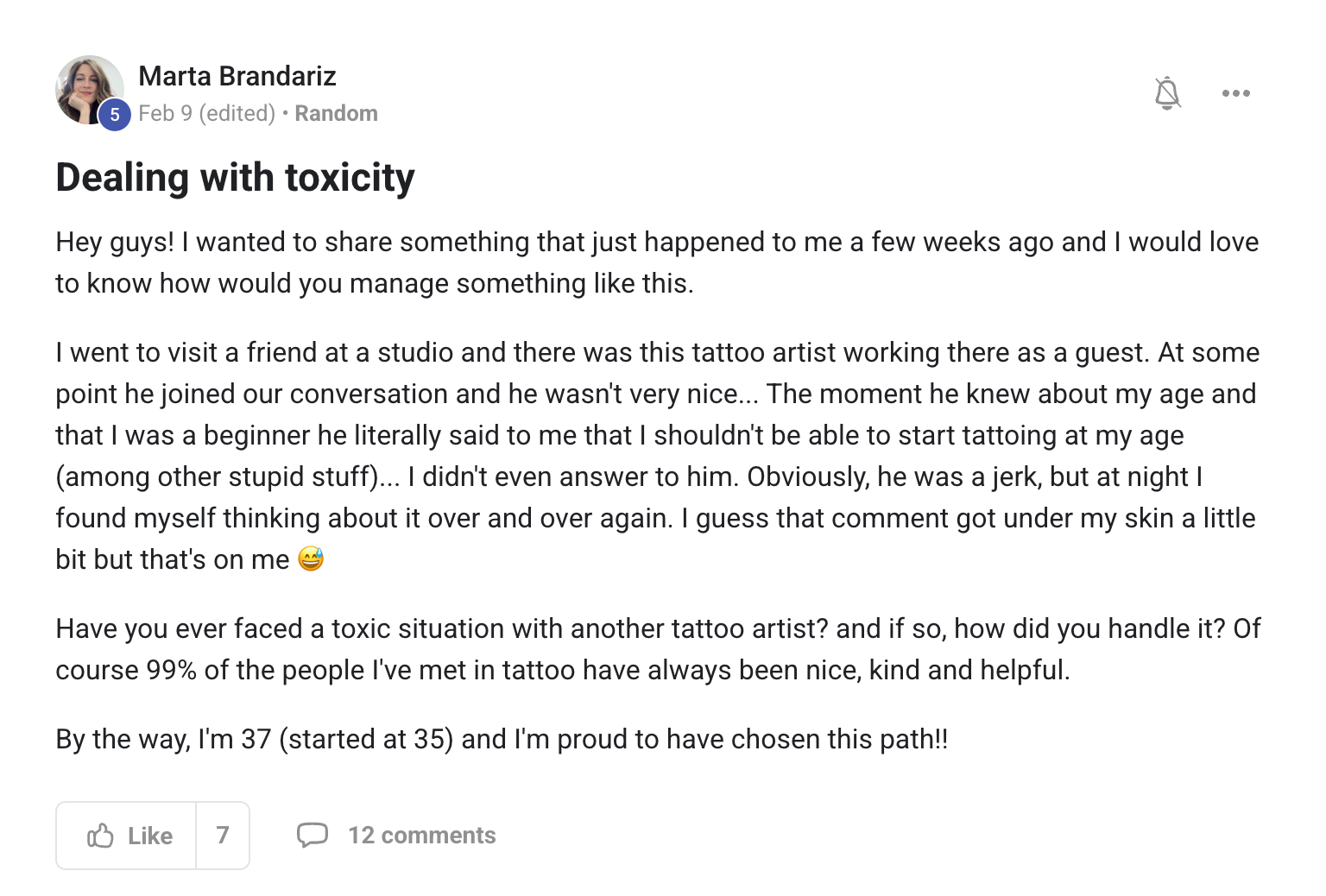
"The moment he knew about my age and that I was a beginner he literally said to me that I shouldn't be able to start tattoing at my age... By the way, I'm 37 (started at 35) and I'm proud to have chosen this path!!"
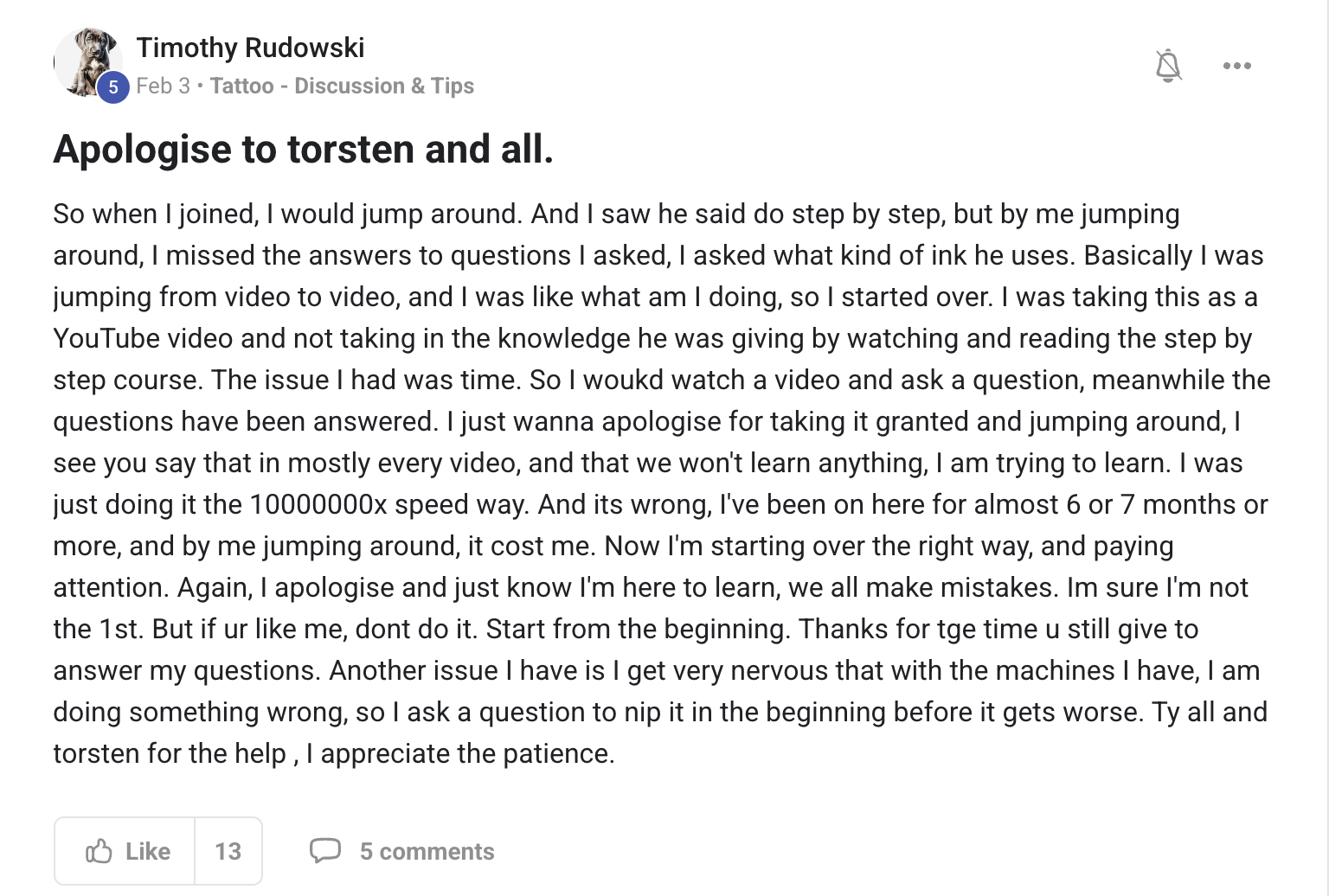
"I was taking this as a YouTube video and not taking in the knowledge hed reading the step by step course... by me jumping around, it cost me. Now I'm starting over the right way. But if ur like me, dont do it. Start from the beginning."
4. A MENTOR IN YOUR CORNER DAILY, and other artist you can trust and grow together
Everybody in this industry has a question they've stopped asking. You watched what happened to someone who asked it — the joke, the screenshot, the you-should-know-that-by-now — and you decided to guess instead. Then you carried the gap for years.
Here you ask it in writing, or you ask it to my face on one of the four live calls every month, the Q&As and the live tattoo critiques. Some of the people answering have twenty years in. Some of them started last month. They're all working through the same system, and nobody here gets told they should already know
"I still feel like I'm processing everything we talked about... The way he guides us, meets us where we are, and pushes us to grow is something really special."
Read more community stories
"Can I just express my happiness of attending the life critique lesson, based on overlooking other people's works and learn the points. That is amazing to hear a professional feedback, can't overestimate the value"
"I've been in a few other ones on different platforms and tbh they have been terrible. People stuck in their old ways. Everyone here has been nothing but respectful, caring, and sharing all their knowledge regardless of experience."
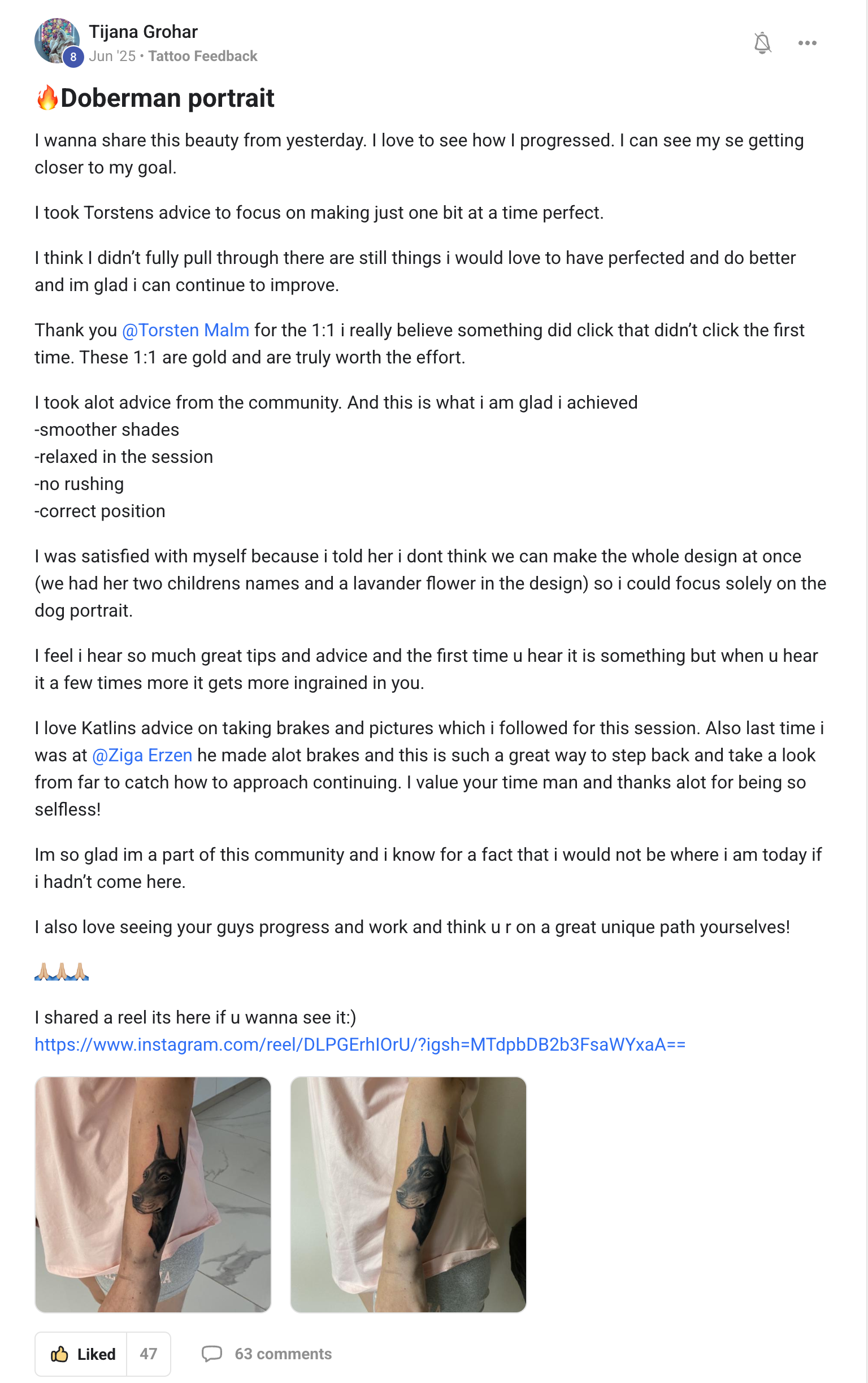
"I took Torstens advice to focus on making just one bit at a time perfect. Thank you Torsten for the 1:1 i really believe something did click that didn't click the first time. These 1:1 are gold."
"I felt lost in and out of studios, experiencing some unbelievably bad conduct to thinking WTF - to now having you guys AND one of the best colour realism artists in the world as a mentor. There isn't nothing else like it"
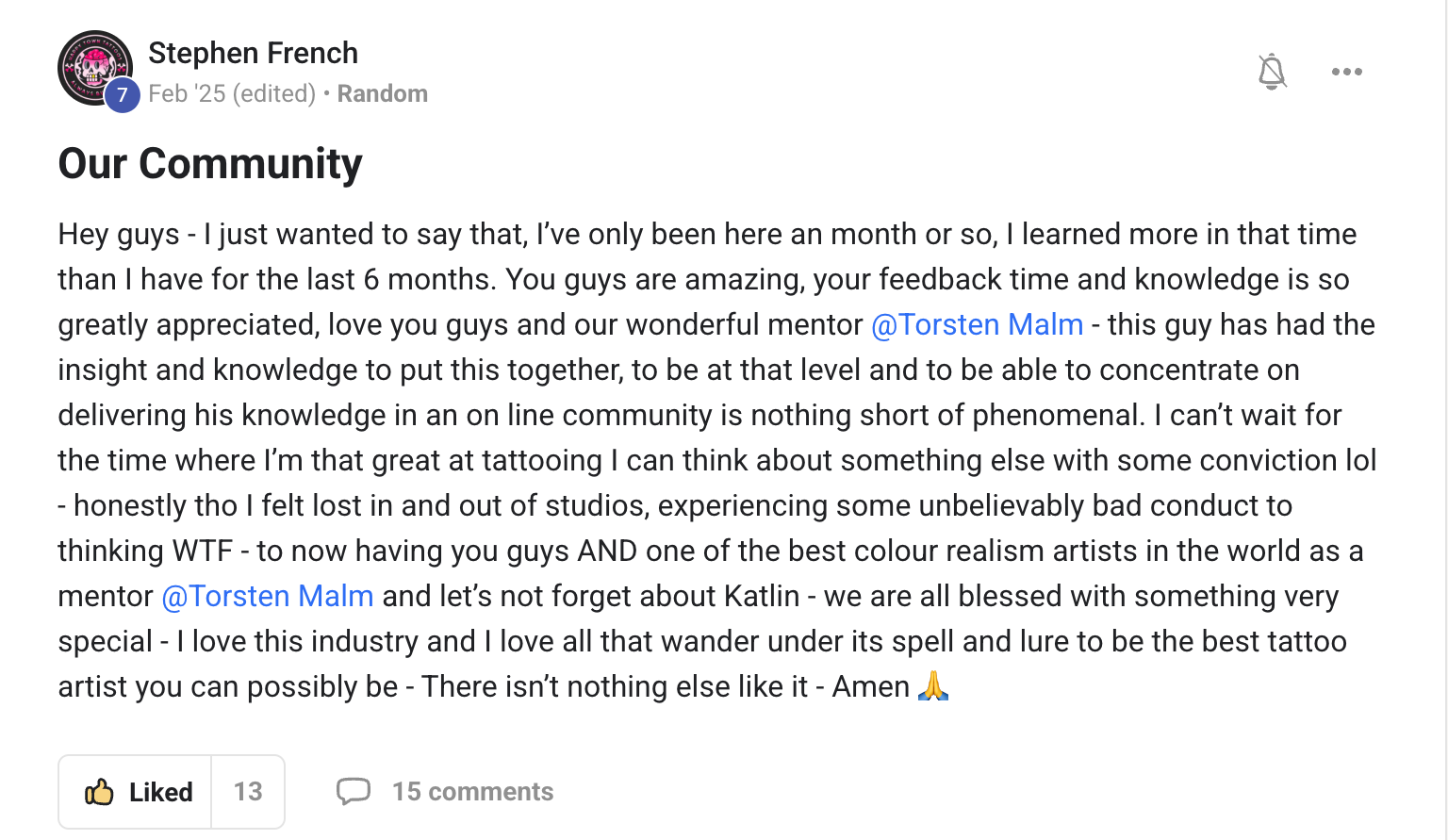
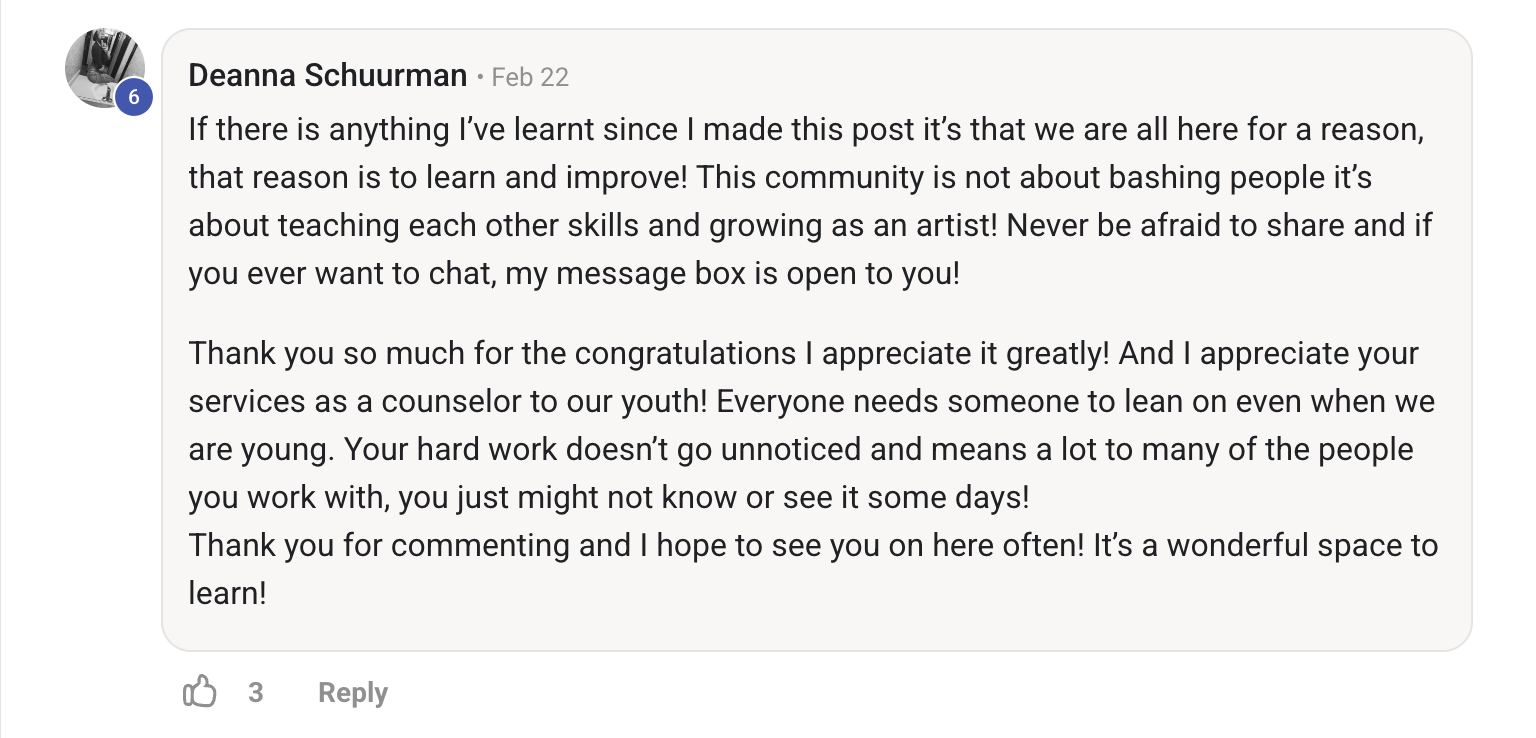
"If there is anything I've learnt since I made this post it's that we are all here for a reason. This community is not about bashing people it's about teaching each other skills and growing as an artist!"
5. BURNED BY SEMINARS AND ONLINE COURSES
You've been burned before, or you've watched it happen to someone. Two grand for a weekend seminar and a notebook to show for it. A course that turned out to be free videos in a different order. So you arrive suspicious, and you should.
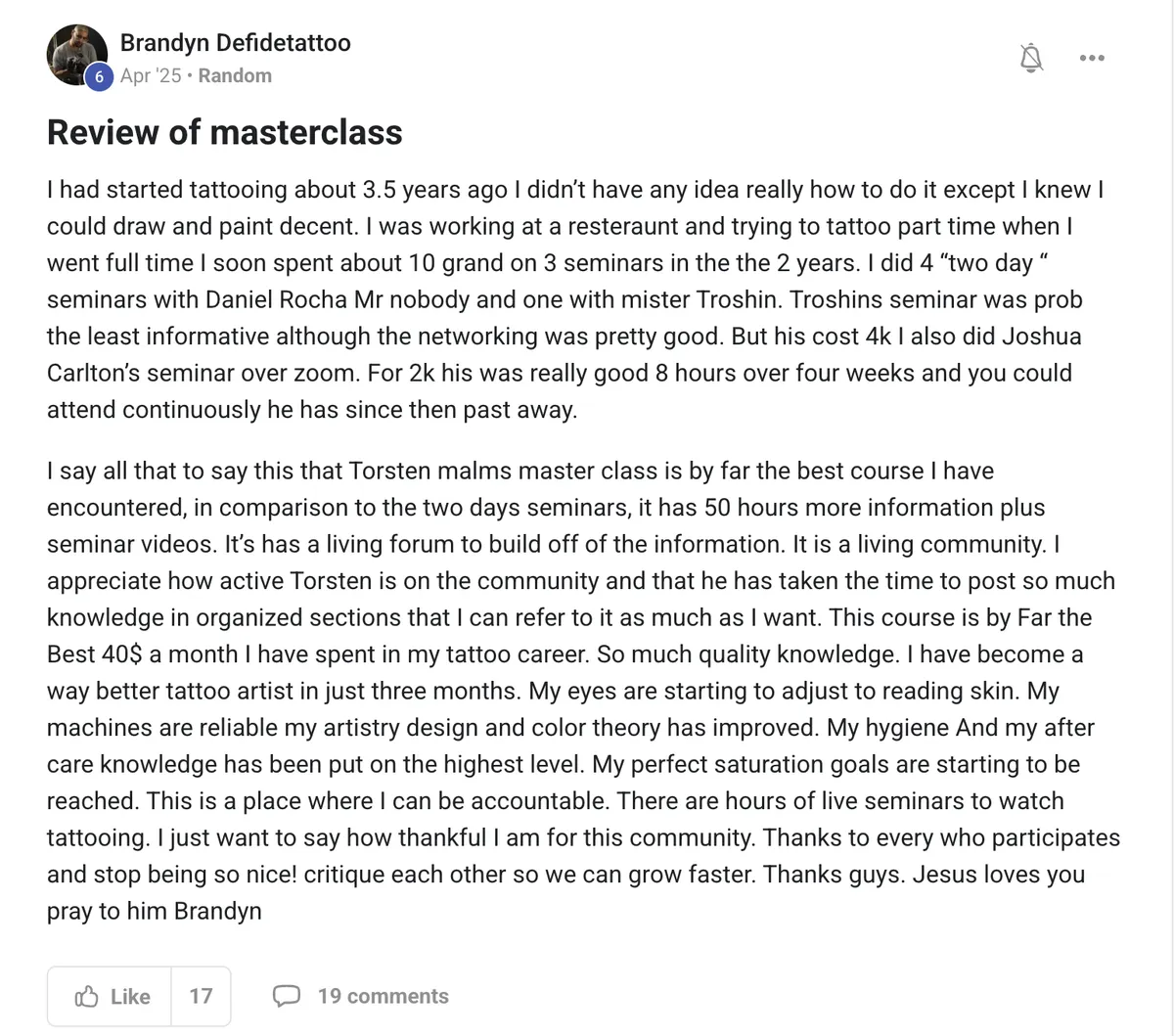
One member spent about ten grand on three seminars in two years before he found this. He calls this the best forty dollars a month he's spent in his whole career. Everyone below has done the same arithmetic
"I soon spent about 10 grand on 3 seminars in the the 2 years... This course is by Far the Best 40$ a month I have spent in my tattoo career."
Read more before you decide
"i plan to do 3 or 4 pages a day! I love this course. The best $39 i ever spent!! So much quality knowledge and I have become a way better tattoo artist already."

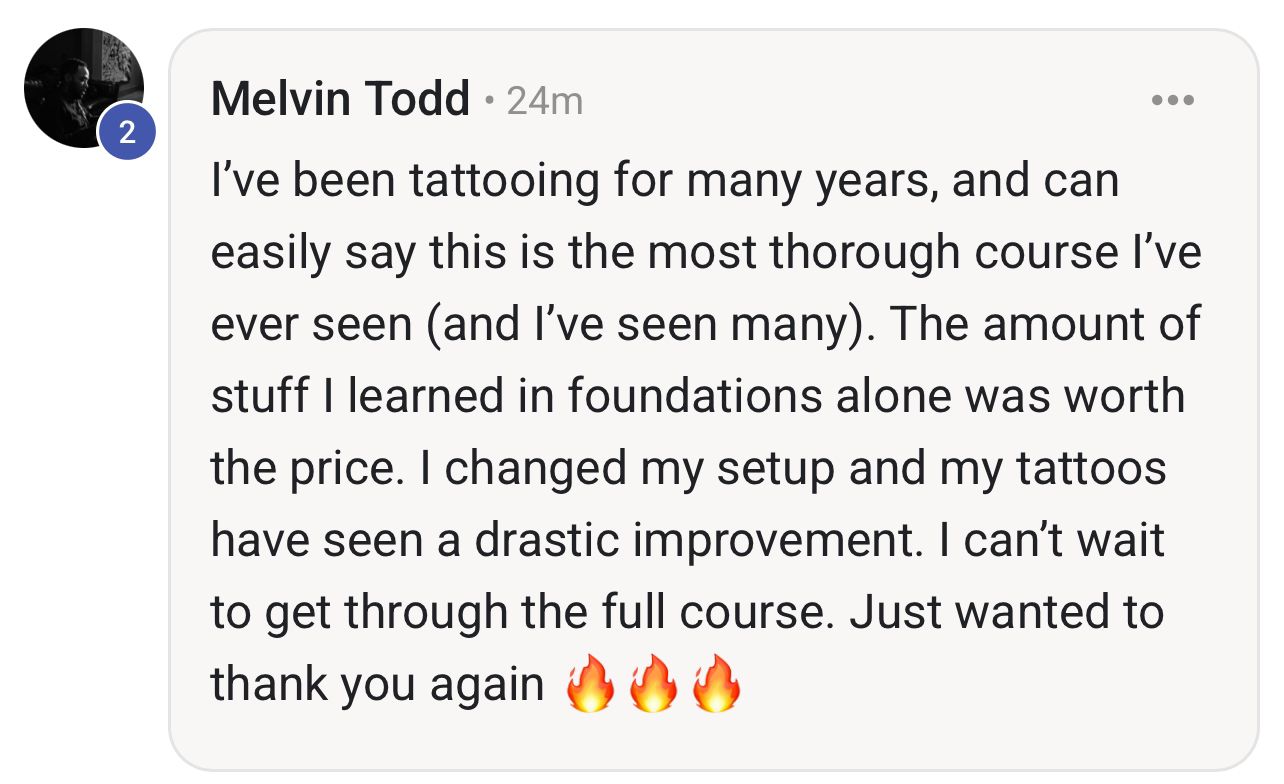
"I've been tattooing for many years, and can easily say this is the most thorough course I've ever seen (and I've seen many). The amount of stuff I learned in foundations alone was worth the price."
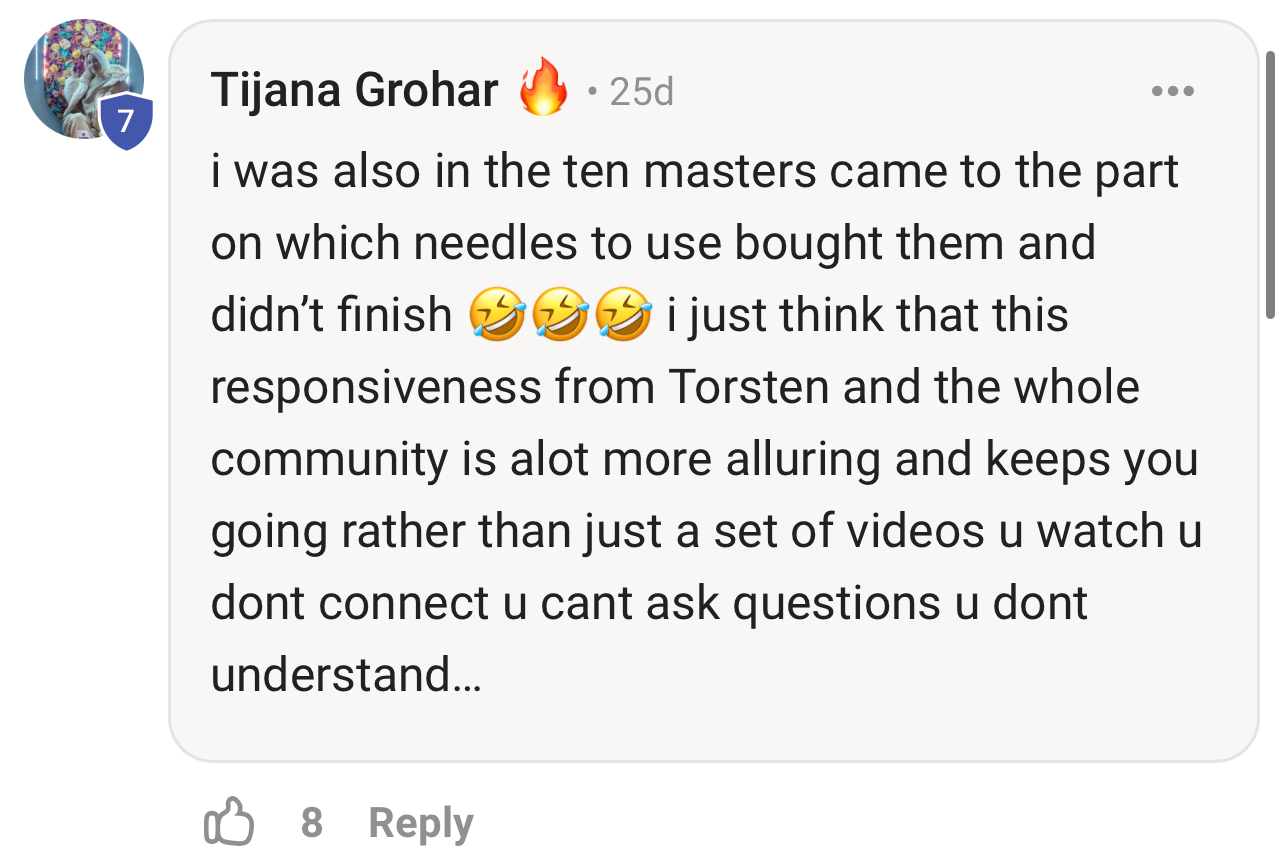
"i was also in the ten masters came to the part on which needles to use bought them and didn't finish i just think that this responsiveness from Torsten and the whole community is alot more alluring"
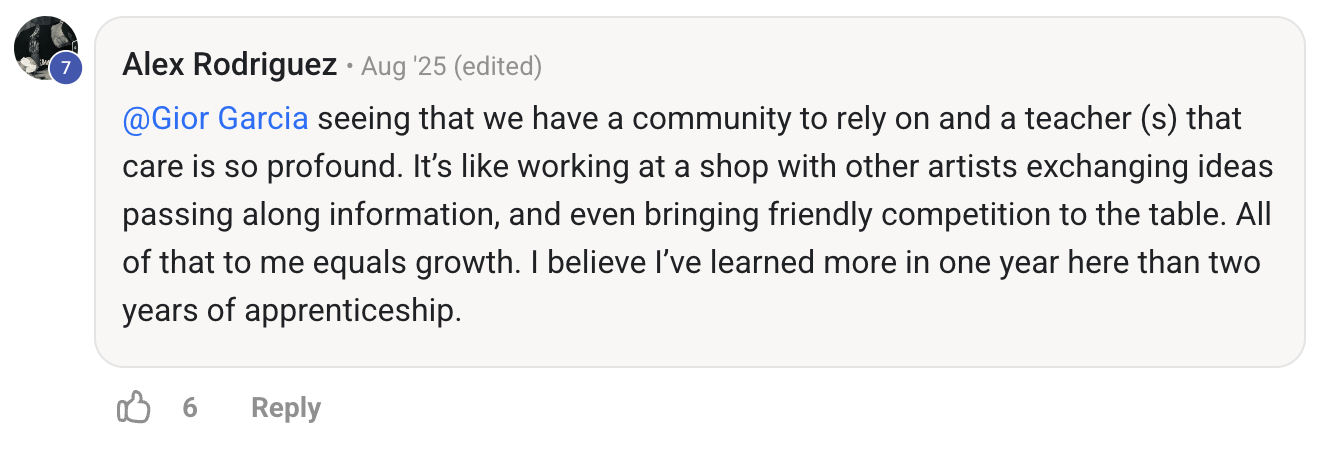
"I cancelled other subscriptions to patreons and stopped mindlessly trying to teach myself. I believe I've learned more in one year here than two years of apprenticeship."
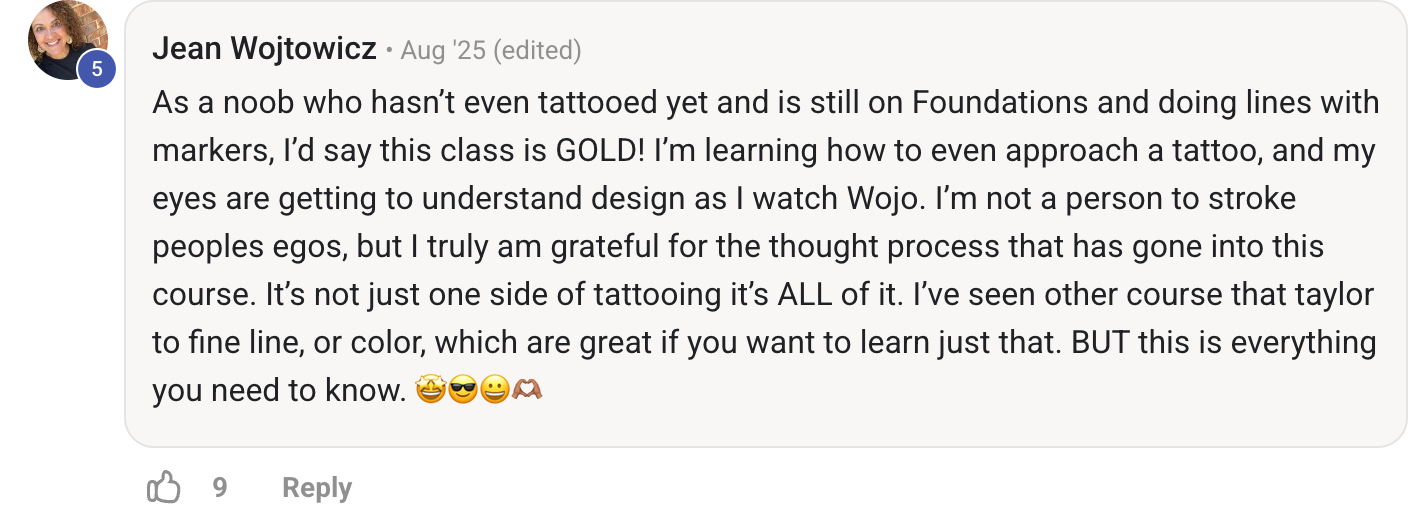
"I'm not a person to stroke peoples egos but as a noob who hasn't even tattooed yet and is still on Foundations, I'd say this class is GOLD! I'm learning how to even approach a tattoo."
6. CONVENTIONS
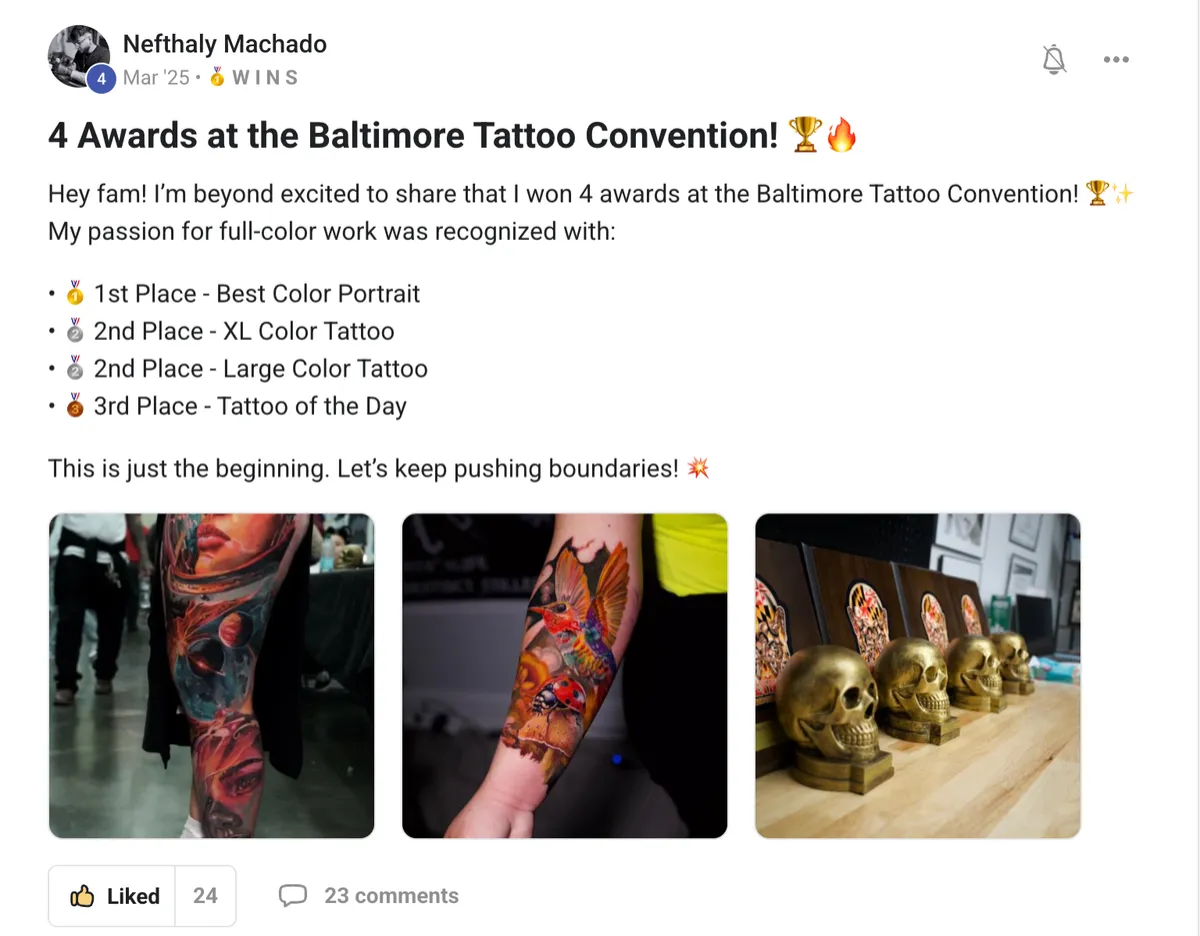
"I'm beyond excited to share that I won 4 awards at the Baltimore Tattoo Convention!"
Read more convention stories
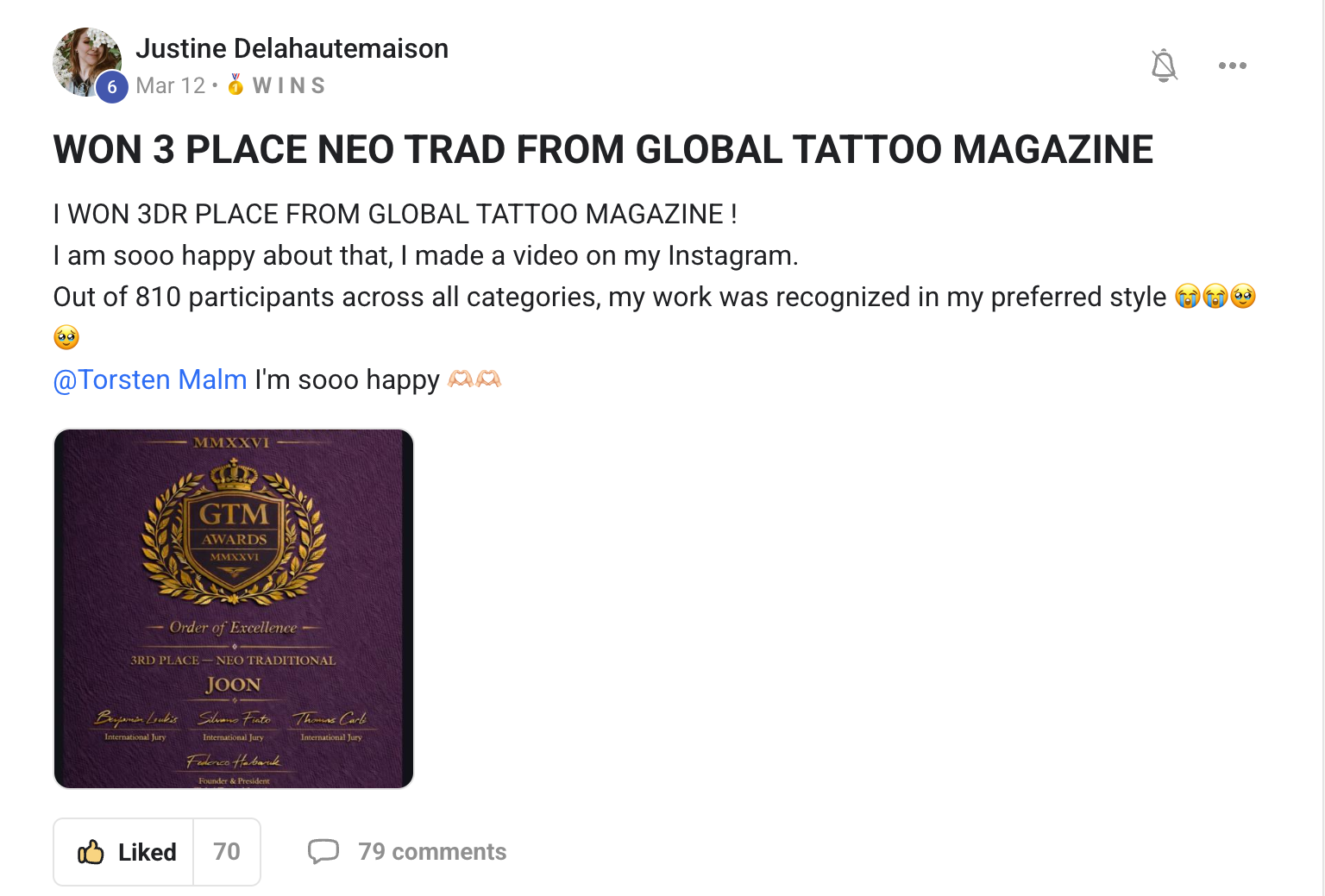
"I WON 3DR PLACE FROM GLOBAL TATTOO MAGAZINE! Out of 810 participants across all categories, my work was recognized in my preferred style."
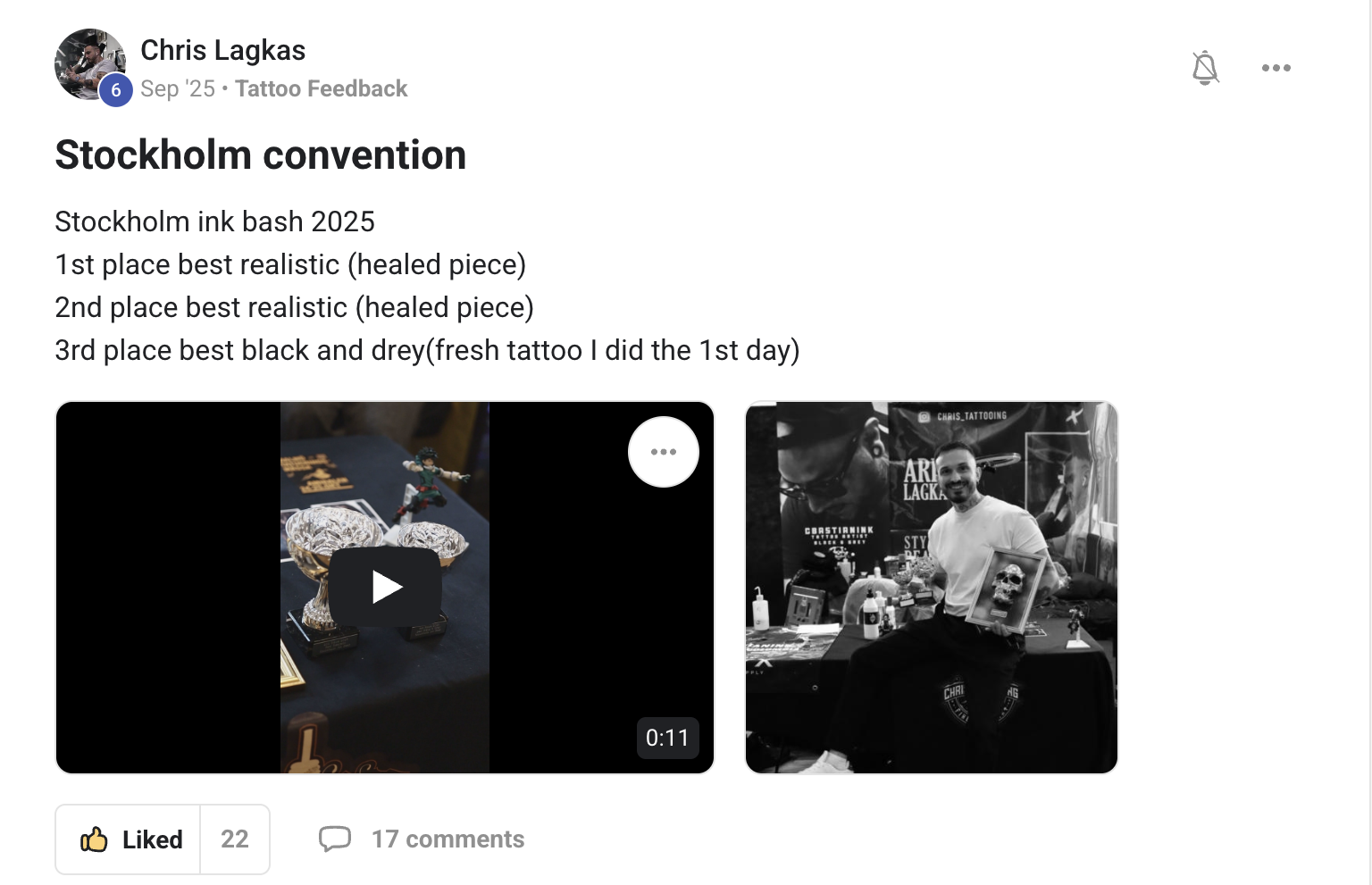
"Stockholm ink bash 2025
1st place best realistic (healed piece)
2nd place best realistic (healed piece)
3rd place best black and drey (fresh tattoo I did the 1st day)"
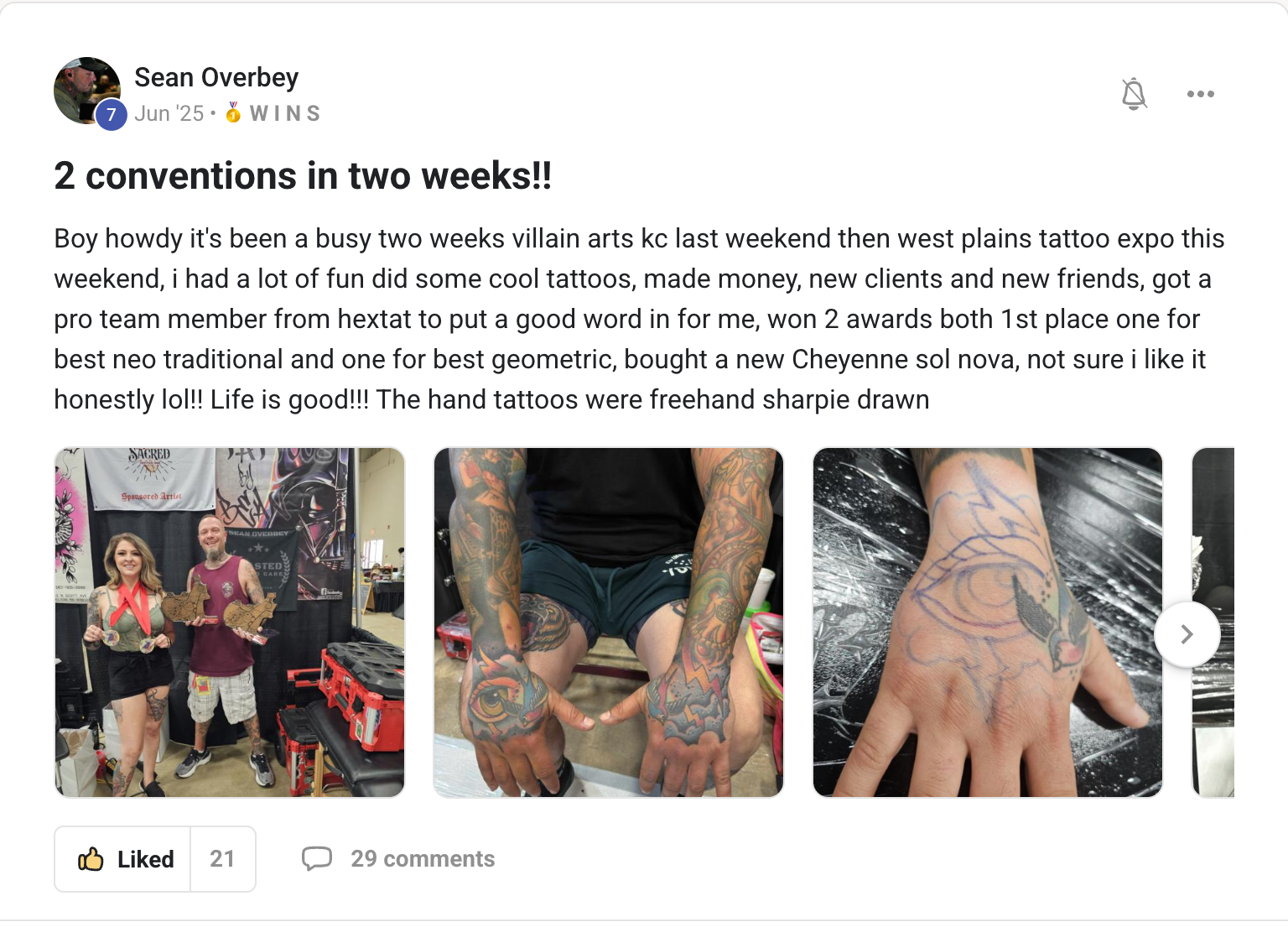
"I had a lot of fun did some cool tattoos, made money, new clients and new friends, won 2 awards both 1st place one for best neo traditional and one for best geometric."
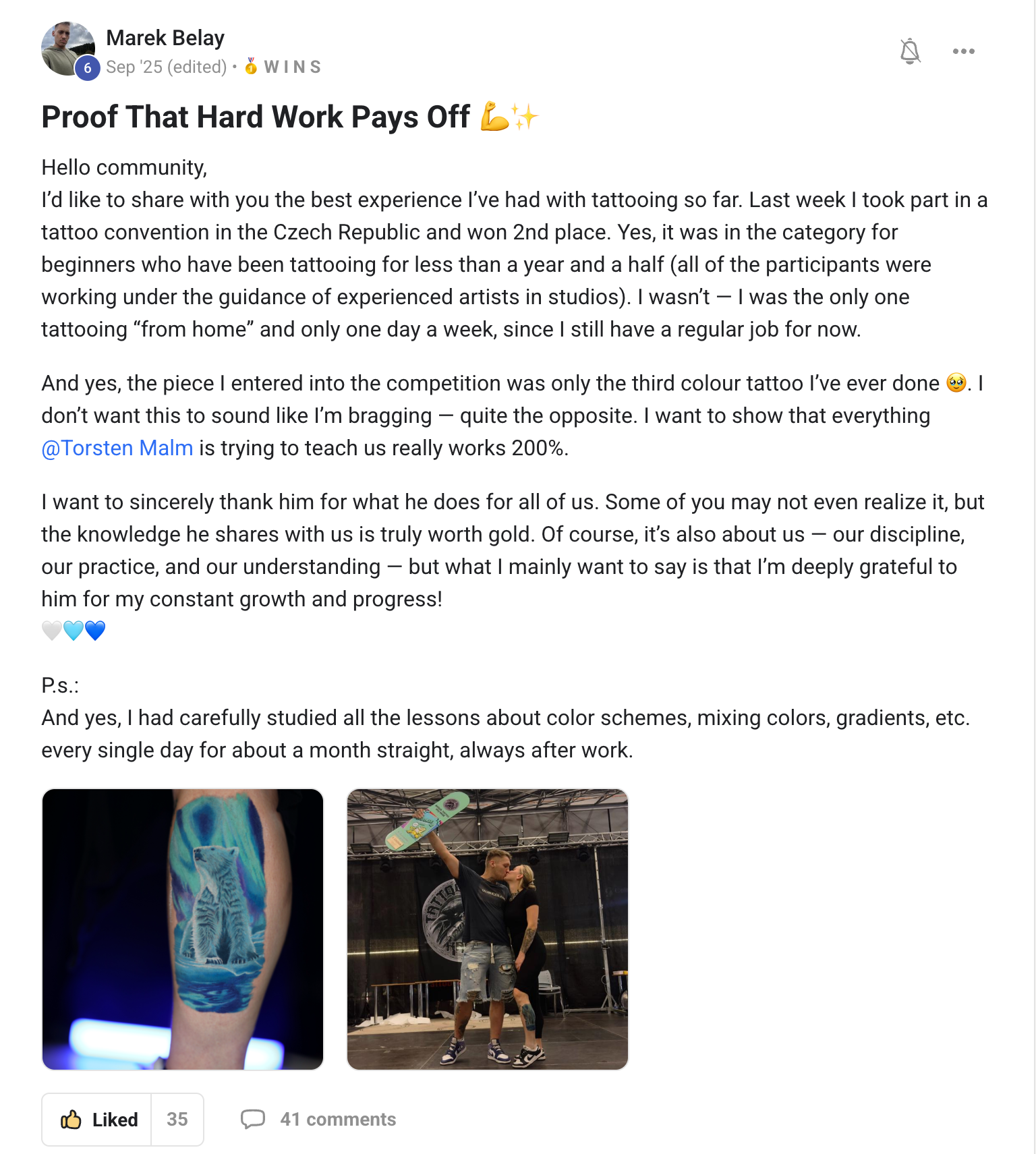
"I took part in a tattoo convention in the Czech Republic and won 2nd place. The piece I entered into the competition was only the third colour tattoo I've ever done."
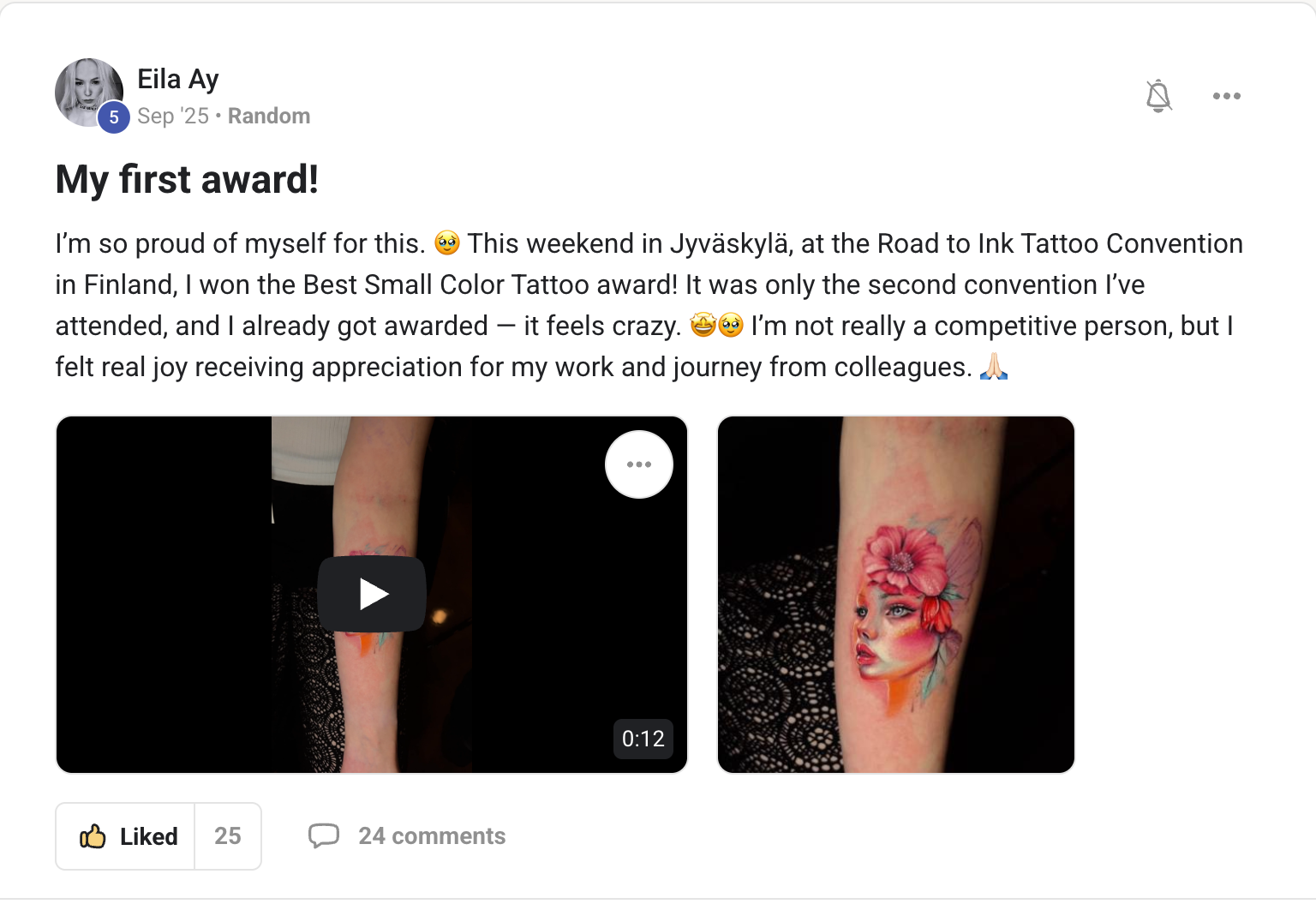
"At the Road to Ink Tattoo Convention in Finland, I won the Best Small Color Tattoo award! It was only the second convention I've attended, and I already got awarded."

My Totally Insane 14 Day Money Back Guarantee
I 100% Guarantee the Full Tattoo Masterclass will blow your mind or I'll refund you for the fee, and let you keep it anyway…
Show me another person who’s willing to stand behind their masterclass like this.
Use the framework and knowledge that make me win over 30 times global tattoo awards and keeping my studio full of high-paying international clients. All 100% risk-free.
*you will be re-directed to my Skool page to join.
When you learn all of this, now you'll be able to have what most artists don't. Options...

All these options can be insanely profitable. They all allow you to make an impact, leave your mark on the world, and change people's lives with your art.
Now, I’m not saying that when you join, you’ll win your first tattoo award in a month or start making $20k–$40k per month right away. But what I am saying is that you’ll gain access to a step-by-step system. If you follow it, there’s no reason you can’t win an award or start making at least $20k–$40k within the next 6–12 months!
You’re reading this page right now because you know something is missing in your career. Maybe it’s the technical skills, the business strategies, or simply a solid system to grow your brand and business. The truth is, if you don’t take action now, six months from today, you’ll likely be in the exact same spot. So...
I GUESS WHAT I'M TRYING TO SAY IS THAT YOU SHOULD...
*you will be re-directed to my Skool page to join.


